From The Starred Well
echoed whispers & green ribbons

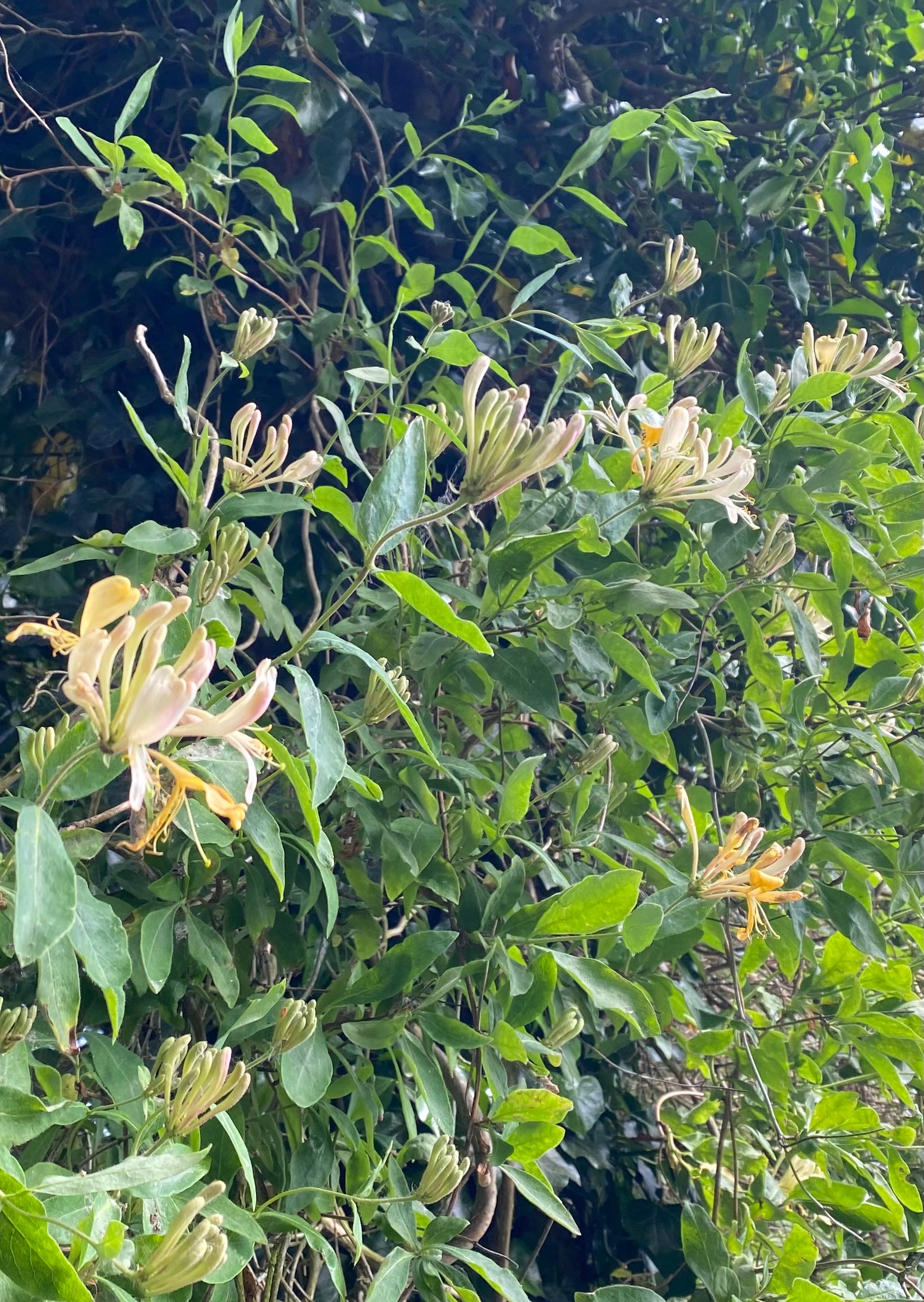
Wild honeysuckle in the hedgerow along the lane. 31 May 2026
Hello, and welcome to this edition of Bracken & Wrack, coming to you just as June tiptoes in trailing elderflowers and wild rose petals in its wake.
What glorious mornings we’ve had recently! Although I’ve often made my way up the hill to sit cross-legged beside the graves of William (died 1816), Mary-Ann (died 1815 aged 8 months) and Susannah Mason (died 1850) with my coffee, there’s really been no need to leave the tiny garden to bring you this early summer wildlife report.
Sitting at the little iron table cast in roses with my writing book yesterday, a loud sawing sound made me look up. I was just in time to witness a group of four swans flying over, the rhythmic scraping of their wings and cries creating an indescribable yet very familiar music. As they passed over the cottage, four screaming swifts crossed their path in the other direction. How different was the swifts’ flight! No straight purposeful line here but a joyous swooping and skimming at a speed that perfectly explains their name.
The lesson seems to be to remember to gaze upwards time and again. I must miss so much wild action every single day, but I’m going to try harder to notice EVERYTHING. The metallic flash of a beloved greenfinch - their numbers have been woefully diminished by disease - as they land on the pinkest of roses growing against the red brick of the forge next door. The forked, spread tail of a red kite in flight. A heron, its shadow running darkly below as it flaps over the nave of the ancient church.
Tell me, what small or large beauties have caught your eye since last we gathered here?
In this edition of Bracken & Wrack:
Tales From The Churchyard: The Visitors’ Book
A Poem In Pieces: Part 2 - Out Of A Saint’s Cell
And The Ladies Go Dancing At Whitsun
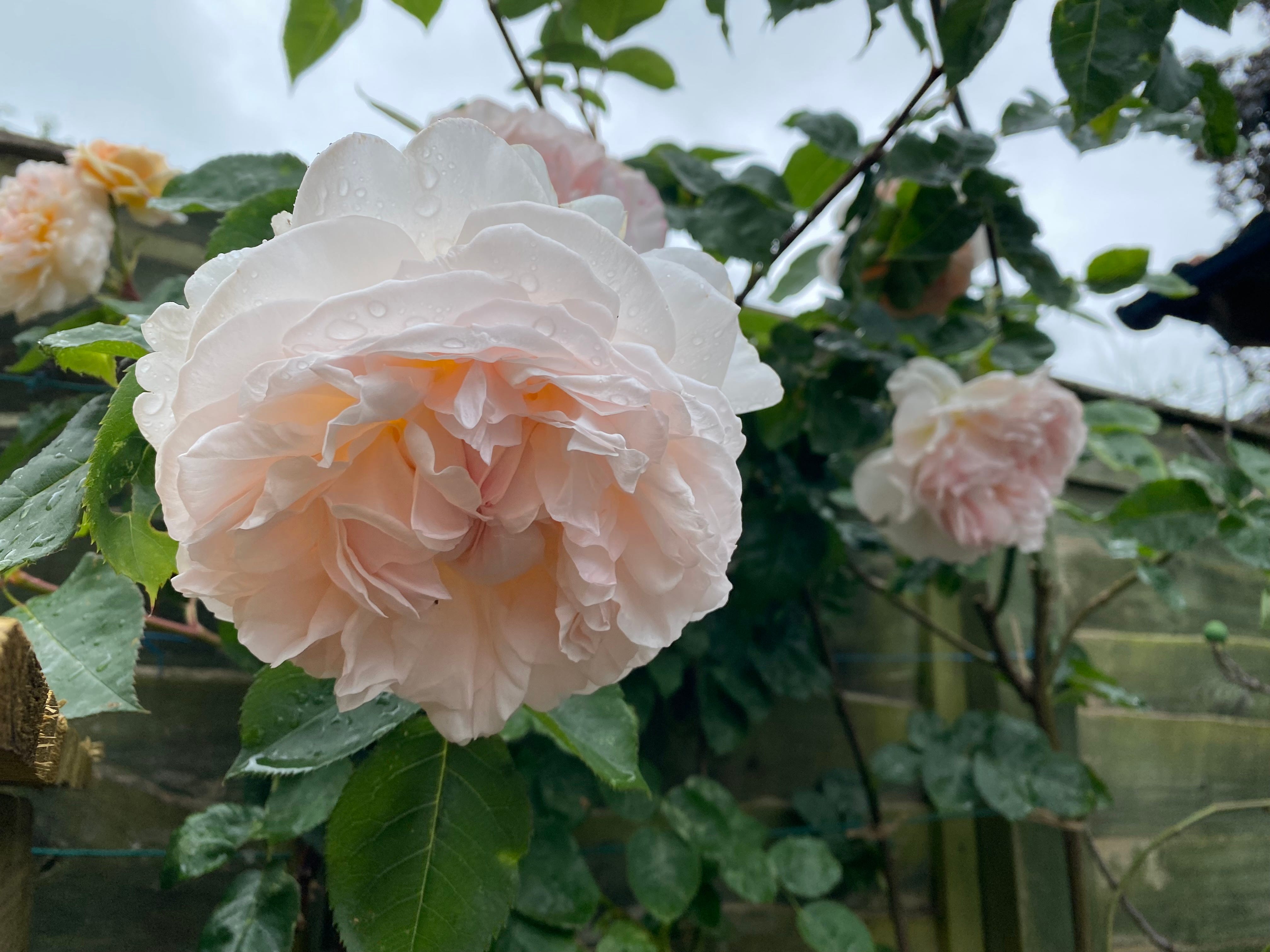
Rosa ‘Bathsheba’ - such an absolute beauty here in the cottage garden. A gift as this rose was already here when we arrived.
TALES FROM THE CHURCHYARD: The Visitors’ Book
We’re on the last stretch of a sunny-afternoon walk to explore our new parish, heading for the church on the hill. The footpaths and lanes still confuse me, but the great tower at least is a constant landmark. A tricksy one, true, as it comes and goes between hedges and cottages. But beyond the churchyard a narrow path through the barley and potatoes will, I know, take us back to the cottage.
Today we approach the church from its public side, all gravelled car park and war memorial. The walk has already inscribed almost a complete circle, the church and the track being the missing stroke.
Our conversation falls to tracks and trails as we pass the enigmatic stone by the church gate. Here we have only flint, so any such megalith has certainly been intentionally placed. This one could be a milestone, except that the weathered carving on its outer face looks far more like a visual representation than lettering.
I’m still tracing the bumps and hollows with my finger as you stride into the car park. Quickening my step, I notice that a vehicle has just pulled up under the shade of a fringe of trees. Its front doors swing open and a couple step down.
‘Susan!’
The driver is an ex-colleague from The Gardens, as my former place of work tends to be known hereabouts. I’d actually bumped into her outside Lidl a week or so ago. Then, we’d exchanged numbers, saying we must meet up soon. And now here she is again, her husband already with his hand on the inner gate, his eyes on the great flint ship rising majestically before us.
My friend is two or three years older than me, her face thin, lively and very brown from the many hours she spends out of doors. Wavy red hair, a touch of wildness. We get on well. I remember now how quickly and cleverly her fingers skim over and around a crochet hook, and her exquisite eye for colour.
Just inside the gate, a weathered bench floats above a sea of frothy cow parsley, greenery, scent and birdsong. Susan gestures towards it before setting down her basket. ‘We come here most days. I sit here with my crochet for an hour while he spends time alone in the church.’
Following Susan’s husband, we crunch our way towards the south door of the medieval church whose presence is by now palpable. You can tell he’s always been a free spirit. Shoulder length hair the colour of wood ash and large silver hoops in both ears give the game away. He’s considerably older than Susan and walks with a bit of a stoop.
Turning to us he speaks and the words don’t come easily, but there’s no mistaking what he asks. Have we been inside the church ourselves? ‘Not often’, I say. Strangely I’ve rarely stepped inside although the churchyard is proving the perfect spot to pour a coffee while writing or editing. The imprint in the lady’s bedstraw and bird’s foot trefoil behind one of the graves testifies to that.
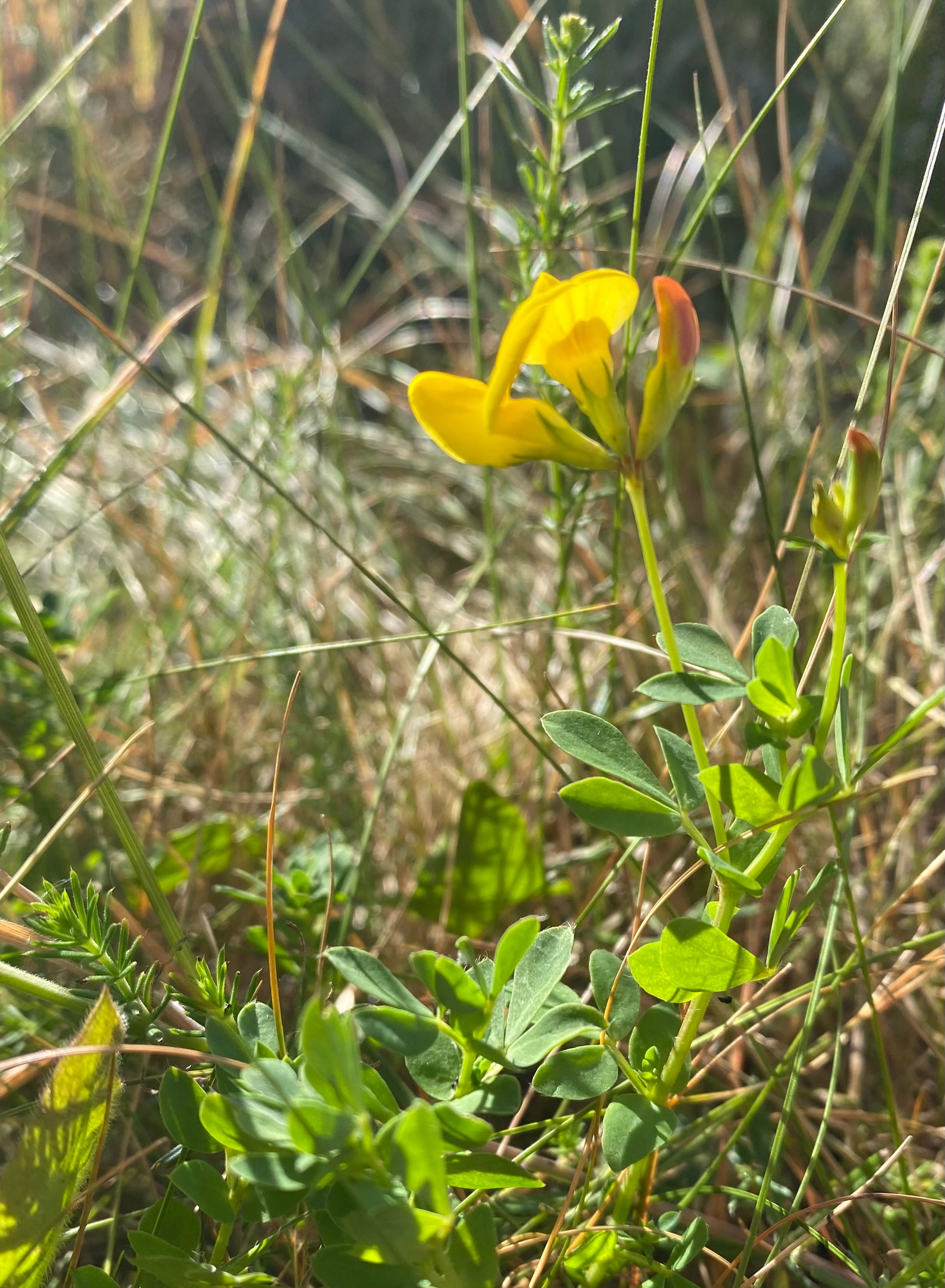
Bird’s Foot Trefoil in the churchyard, 1 June 2026
Now, Susan’s husband steps into the porch and turns the heavy iron ring. Beckoning us inside, he’s already at the welcome table, flicking through the visitors’ book. ‘That’s me’ - pointing to a recent entry. Then, turning back the pages, ‘and here, and here’. His finger touches gently on his own name. Then he comes to a double page where the same name - abbreviated to sprawling initials - has been faithfully dated and recorded day after day and wordlessly he runs his finger under each glyph as if to underline it.
Meanwhile, outside among the waving wildflowers Susan crochets her own prayer to beauty and hope.
It’s time to leave this man to his quiet time. Saying our goodbyes we turn back to the great oak door in this place of echoed whispers. He smiles as he shuts it gently behind us.
As the cottage draws closer with each footstep I imagine his spirit melting into the carved stone, wood and glass. Perhaps, even, into the very flint that seems to grow out of the land here. The flint that rearranges itself into a vessel filled to bursting with the joys, sorrows and yearnings of the owners of those countless feet that have climbed the hill before ours.
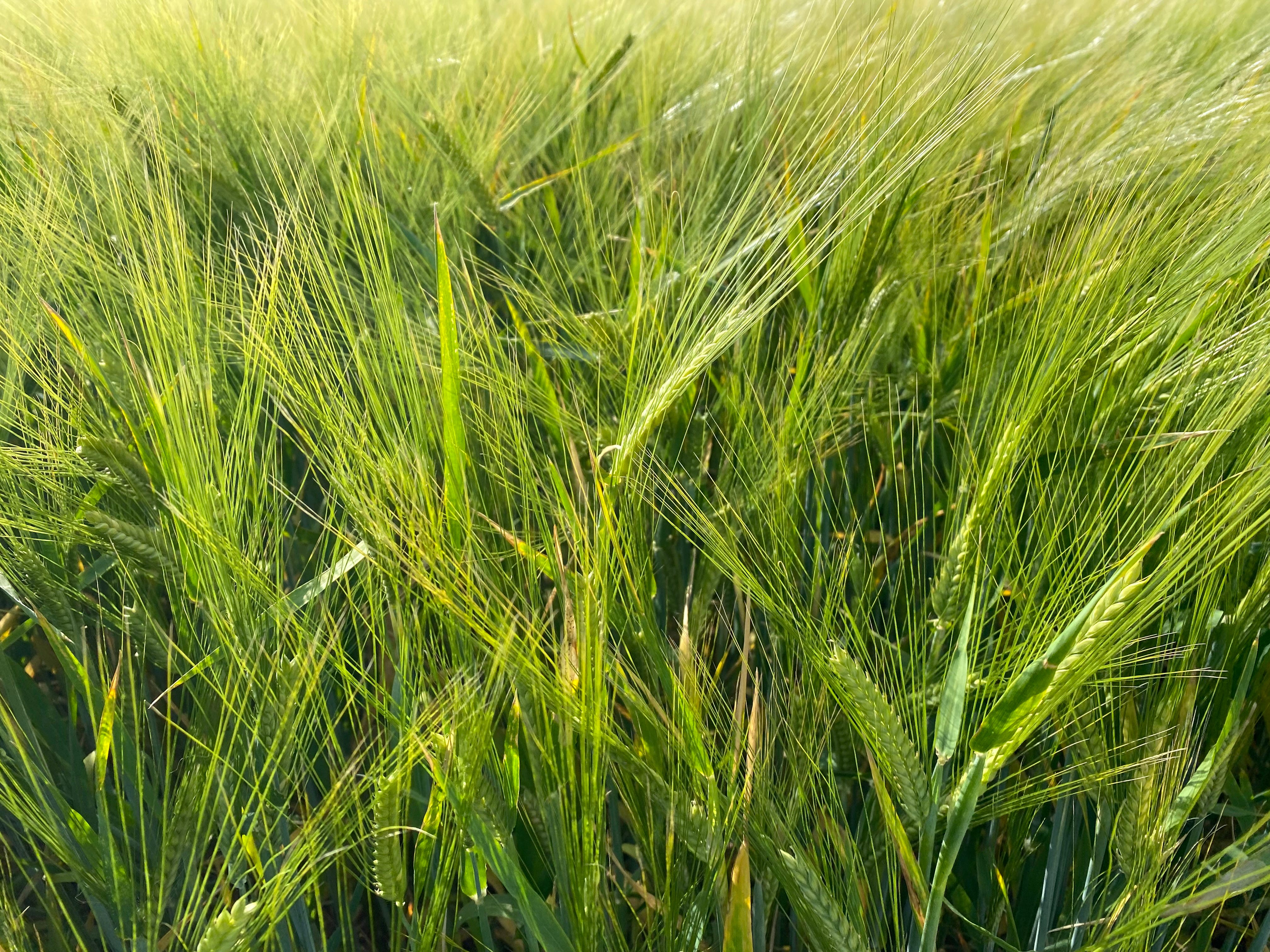
Barley ripening on the hill, 28 May 2026
A POEM IN PIECES: Part 2 - Out Of A Saint’s Cell
In The Dew Dipped Year - the last edition of Bracken & Wrack - I explained that I would find Dylan Thomas a very difficult poet if I insisted on understanding the intended meaning of every one of his words, but that I had come to adore the feel, shape and sound of them for their own sake.
If you read that article you’ll know that I plan - possibly heretically - to divide one of Thomas’s poems that I find thrillingly beautiful into several segments of a couple of stanzas each, and set these out here as a short series. That way we can linger over the words and phrases more readily and who knows, perhaps like me you will feel inspired to work creatively with them :-)
(Click below to hear an audio version of the extract.)
Nor the innocent lie in the rooting dingle wooed
And staved, and riven among plumes my rider weep.
From the broomed witch’s spume you are shielded by fern
And flower of country sleep and the greenwood keep.
Lie fast and soothed,
Safe be and smooth from the bellows of the rushy brood.
Never, my girl until tolled to sleep by the sternBell believe or fear that the rustic shade or spell
Shall harrow and snow the blood while you ride wide and near,
For who unmanningly haunts the mountain ravened eaves
Or skulks in the dell moon but moonshine echoing clear
From the starred well?
A hill touches an angel. Out of a saint’s cell
The nightbird lauds through nunneries and domes of leaves
Dylan Thomas ‘In Country Sleep’ (extract)
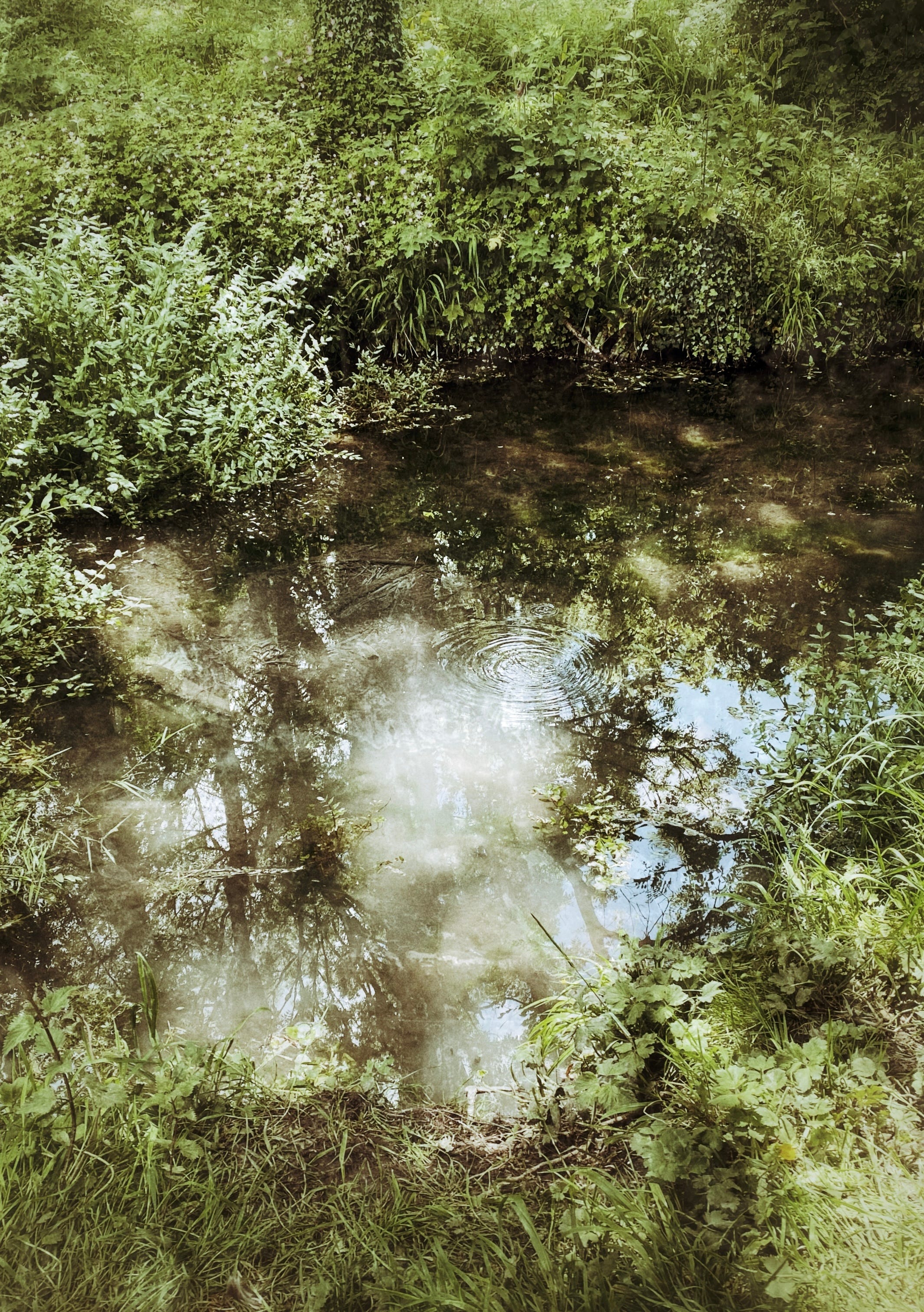
Magical well/sacred spring at Alton Barnes, Wiltshire on a Whitsuntide adventure of two years ago. 25 May 2024
AND THE LADIES GO DANCING AT WHITSUN
The word Whitsun (Whit Sunday) refers to the Christian festival of Pentecost which falls on the seventh Sunday after Easter and commemorates the descent of the Holy Spirit into Jesus’ disciples. Me being me, I can’t help but notice that magical ‘seven’ here. Now, the suffix ‘tide’ is a favourite of mine, in one stroke extending a single festival day into something that allows the feeling of the season to gently unfold. I tend to bandy ‘tide’ around very freely but until recently I hadn’t known that Whitsuntide has the specific meaning of the week following Whit Sunday. Let’s not get into the fact that a week contains seven days :-)
This particular tide would have been eagerly looked forward to by every medieval villein. It marked one of three holiday weeks each year when, in most manors, the labourers were free from service on the Lord’s estate. Whit Monday, the day after Whitsun, was given Bank Holiday status in 1871 and remained a holiday in Britain until 1972, when it was replaced by a fixed Spring Bank Holiday on the last Monday in May.
Depending upon when Easter falls in any given year, the ‘real’ date of Whitsun can vary quite widely. This year’s (2026) date of 25 May did indeed coincide with the last Monday in May, but last year Whit Monday fell on 9 June and next year it will be 17 May.
Not surprisingly, given that it heralded one of the few pauses in the agricultural round and the first holiday of the year, Whitsun has traditionally been a great excuse for celebration. Up and down the land, communities would hold their annual fair or Whitsun Ale at this time which despite quasi-religious elements was usually pretty wild and boisterous, incorporating games, sports, dancing and plenty of drinking.
Even among the poorest families it was the custom well into the twentieth century for children to be given a new set of clothes to wear on Whit Sunday. Many had so few clothes apart from hand-me-downs and school uniforms that Whitsun was as eagerly looked forward to as Christmas. I read that in South Wales, the new outfit would be chosen at the nearest town and then each village would hold a Whit March when the children were able to walk around the route in their new finery before attending a church or chapel service and enjoying a special tea, the like of which they would rarely see in their own homes. Jelly, ice cream, sandwiches, crisps and cakes added up to a veritable feast.
In the North West of England, church and chapel parades called Whit Walks still take place during this week. The northern collieries and factories were always famed for their brass bands and choirs, and these often feature in the procession, along with streams of girls in white dresses.
With the coming of industrialisation, whole towns were closed down for a week in order to clean and maintain the machinery in the mills and factories. Seemingly as a direct legacy of the medieval holiday week, this closure was often held at Whitsuntide.
A report in John Harlan and T T Wilkinson’s Lancashire Folk lore (1882) reads:
It is customary for the cotton mills etc., to close for Whitsuntide week to give the hands a holiday; the men going to the races etc. and the women visiting Manchester on Whit-Saturday, thronging the markets, the Royal Exchange and the Infirmary Esplanade, and other public places, and gazing in at the shop windows, whence this day is usually called ‘Gaping Sunday’.
Interestingly, a similar tradition lingers to this day and at least one large local factory that I know of does exactly this. The whole place shuts for the week following Spring Bank Holiday Monday and all staff have to take a week of their annual leave while the machines and systems, too, take a rest or are overhauled.
In the Peak District this Whit weekend we noticed that, although the Well Dressing season (a Derbyshire tradition involving decorating wells and drinking fountains with clay panels impressed with elaborate images made from petals, leaves and pulses) started on May Day and continues through the summer, the calendar shows there’s a marked preference for villages to time their celebrations for these few days.
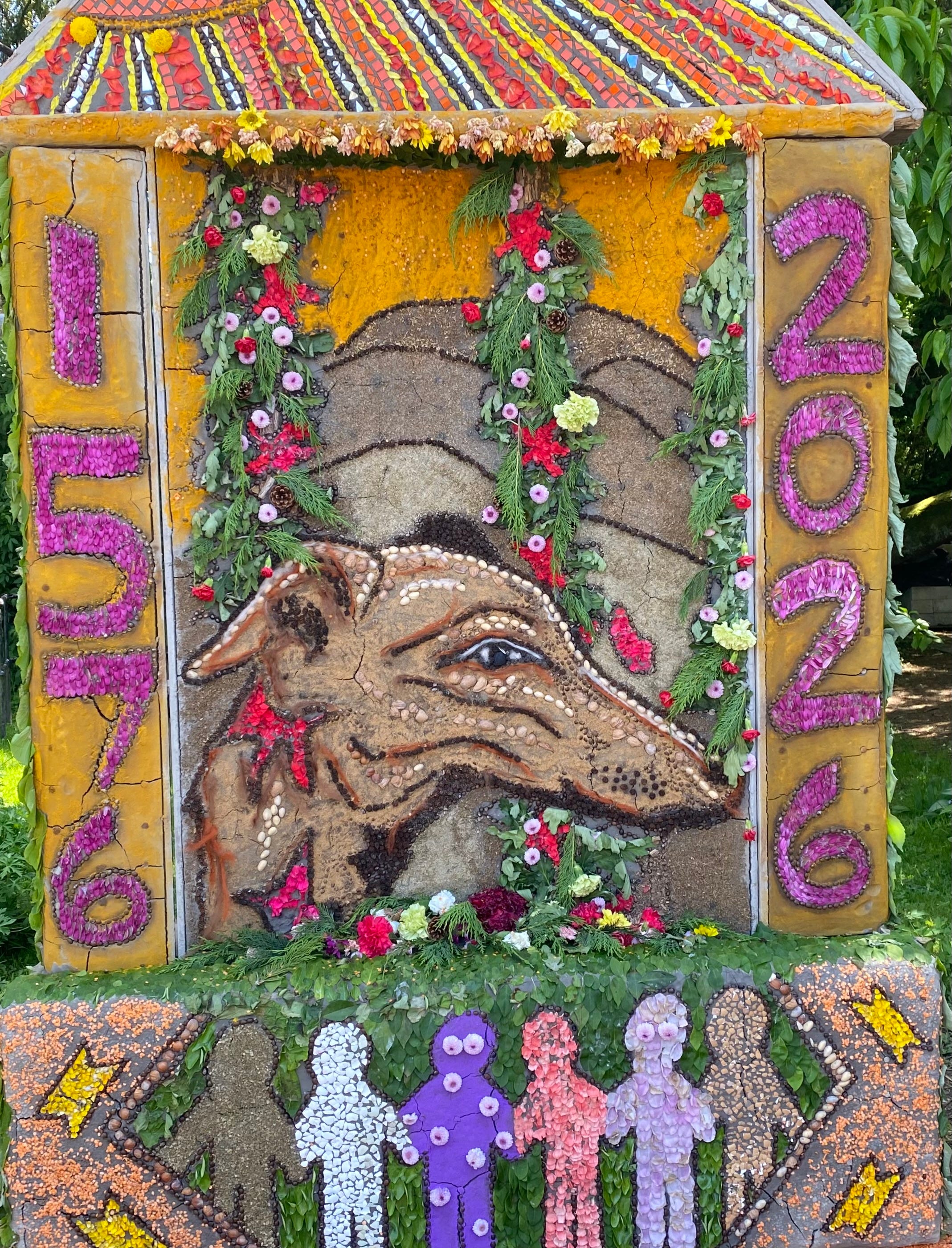
Well Dressing, Wirkswirth, Derbyshire, 24 May 2026
We were in Wirksworth near Matlock on Whit Saturday and witnessed the blessing by local clergy of some of the town’s decorated panels. Here too, a brass band participated in the ceremony which is quite an unusual sight for East Anglians but makes perfect sense when you realise that this area was once rich in mills and lead mines.
Further south, Whaddon in Cambridgeshire has its own unique Whitsun tradition. The men of the village go into the woods early on Whit Sunday and cut branches of oak which they place on every doorstep before moving from house to house singing ‘The Whitsuntide Carol’.
Morris dancing, too, was often associated with Whitsun, although these days it’s more commonly encountered during the May Day Celebrations. It was actually a song about ‘Dancing at Whitsun’ that prompted this piece of writing.
I’d heard this song a couple of times recently during local Folk Nights as Whitsun approached, and a little research revealed that rather than being traditional it was actually written in the late 1960s by Austin John Marshall, whose then wife Shirley Collins recorded it as a demo in 1968. It’s since been recorded by folk artists including Maddy Prior & Tim Hart, and many others.
Then, happening to be taking part in an Open Mic at Matlock Bath in Derbyshire on Whit Sunday itself, one of the performers there sang the song, saying almost apologetically that he knew it was an unusual choice for the event but it felt appropriate for that day. And it was hearing ‘Dancing At Whitsun’ for the third or fourth time this spring that really piqued my curiosity and made me want to find out more about it.
As the sleeve notes explain on the version recorded by Priscilla Herdman on her album The Water Lily:
‘The tradition of Morris Dancing had been performed exclusively by men for several hundred years. During the First World War, when the male mortality rate in some English towns and villages approached seventy percent, this tradition would have been lost were it not for the women who chose to carry it on. Austin John Marshall has written this poignant song as a tribute to the widows, sweethearts, sisters and daughters of those men, who kept the tradition alive.’
It’s fifty-one spring-times since she was a bride,
And still you may see her at each Whitsuntide
In a dress of white linen and ribbons of green,
As green as her memories of loving.
The feet that were nimble tread carefully now,
As gentle a measure as age do allow,
Through groves of white blossom, by fields of young corn,
Where once she was pledged to her true love.
The fields they stand empty, the hedges grow free,
No young men to tend them or pastures go see.
They have gone where the forests of oak trees before
Had gone to be wasted in battle.
Down from their green farmlands and from their loved ones
Marched husbands and brothers and fathers and sons.
There’s a fine roll of honour where the Maypole once was,
And the ladies go dancing at Whitsun.
There’s a row of straight houses in these latter days
Are covering the Downs where the sheep used to graze.
There’s a field of red poppies and a wreath from the Queen.
But the ladies remember at Whitsun,
And the ladies go dancing at Whitsun.
Austin John Marshall, ‘The Whitsun Dance’ (aka ‘Dancing At Whitsun’)
Searching for a version of ‘Dancing At Whitsun’ to share with you here, the one that I found the most touching was this recording by Rosie Hodgson & Rowan Piggott. I hope you’ll enjoy it too.
Until next time.
With love, Imogen x
Thank you. What a beautiful, poignant song