Something Bright
woodsmoke & bryony

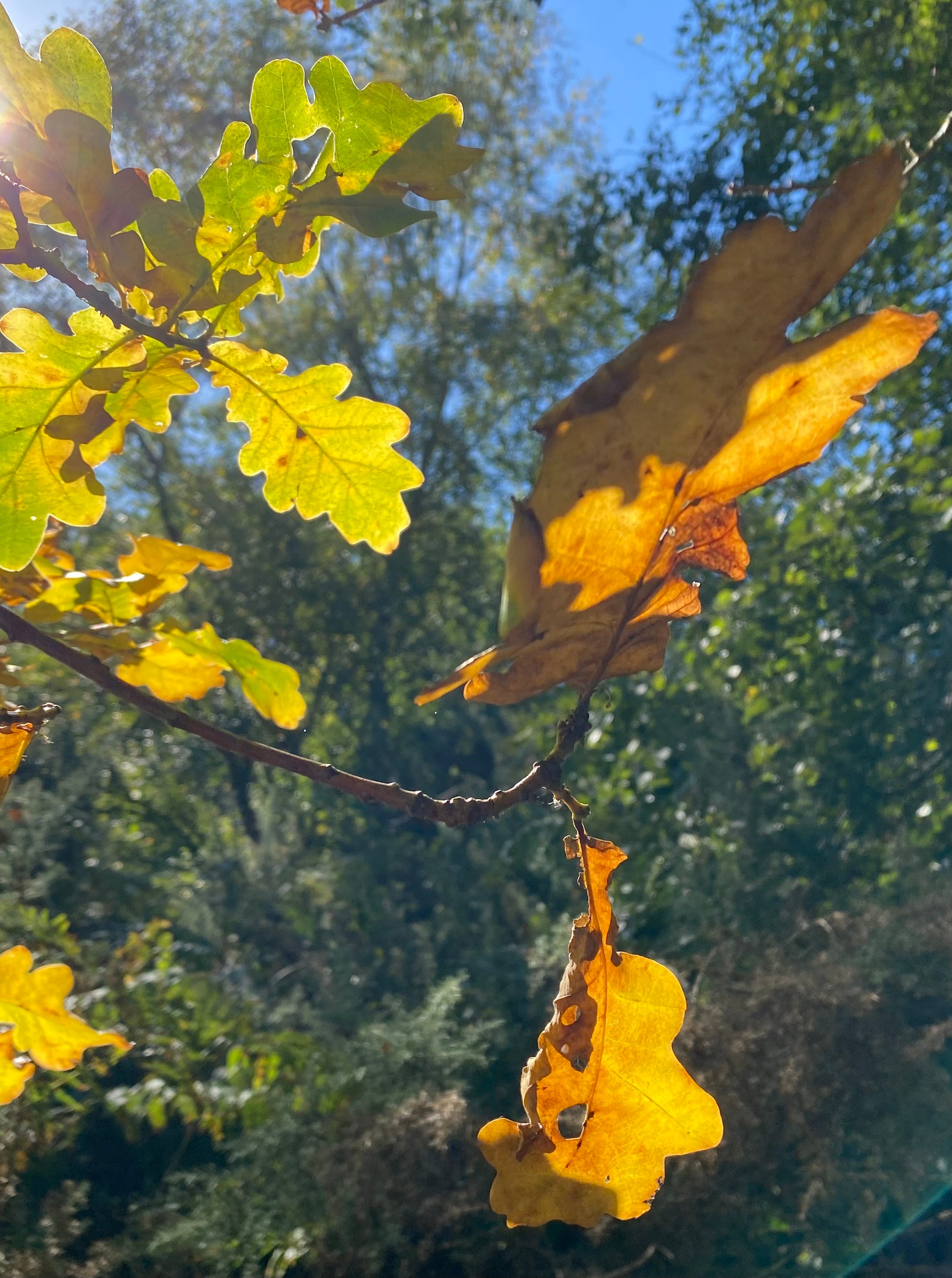
October sun illuminating a cluster of oak leaves on the edge of Crow Wood, 6 October 2025
In the other gardens
And all up in the vale,
From the autumn bonfires
See the smoke trail!
Pleasant summer over,
And all the summer flowers,
The red fire blazes,
The grey smoke towers.
Sing a song of seasons!
Something bright in all!
Flowers in the summer,
Fires in the fall!
Robert Louis Stevenson, ‘Autumn Fires’
Hello, and a very warm welcome to our Full Moon in October edition of Bracken & Wrack! There’s something to celebrate, as today actually IS the date of the full moon, something that hasn’t quite happened in recent months ;-)
Some say the October full moon is Hunters’ Moon but technically Harvest Moon is the one closest to the autumn equinox. And what a beautiful Harvest Moon it is. The cottage’s sitting room window faces east, which means fabulous sunrises (as far as you can see them through the encroaching vegetation) but, especially, wonderful views of the full moon rising.
Ooh, I suddenly realised I’d just typed the title of a half-remembered song! So of course I had to check it out, and found a rather lovely version by the original artist recorded in a shed. I’ll link it here in case, like me, you’re finding yourself in the thrall of the moon as she rises over stubble field and sea:
In fact, so smitten was I that I found myself continually gazing through the window when I was supposed to be fully focussed on practising our ukulele/voice/recorder arrangement of ‘Scarborough Fair’ yesterday evening :-)
But I’m getting ahead of myself, as it was yesterday afternoon under a clear blue October sky that I set out for a walk along the lane to witness the changes brought in by autumn.
Speaking of which, we are right in the middle of Michaelmas-tide, which is how I think of the thirteen days between Michaelmas (29 September) and Old Michaelmas (12 October).
Theoretically, because of the shift in dates, we could still be eating blackberries without fear of ingesting the Devil’s spit (or worse). But this strange dry summer has put paid to that, as despite the thousands of berry-clusters still thrusting stiffly from the vines I don’t think there’s a single edible fruit among them. The pink unripe berries dotted here and there probably won’t mature enough for human consumption now, but I’m hopeful that they will at least help to lessen the hunger of the wild creatures who share this corner of Norfolk with me.
And if those creatures happen to enjoy eating acorns, they have a feast in store as it’s a ‘mast’ year and I don’t think I’ve ever seen the ground so thickly carpeted.
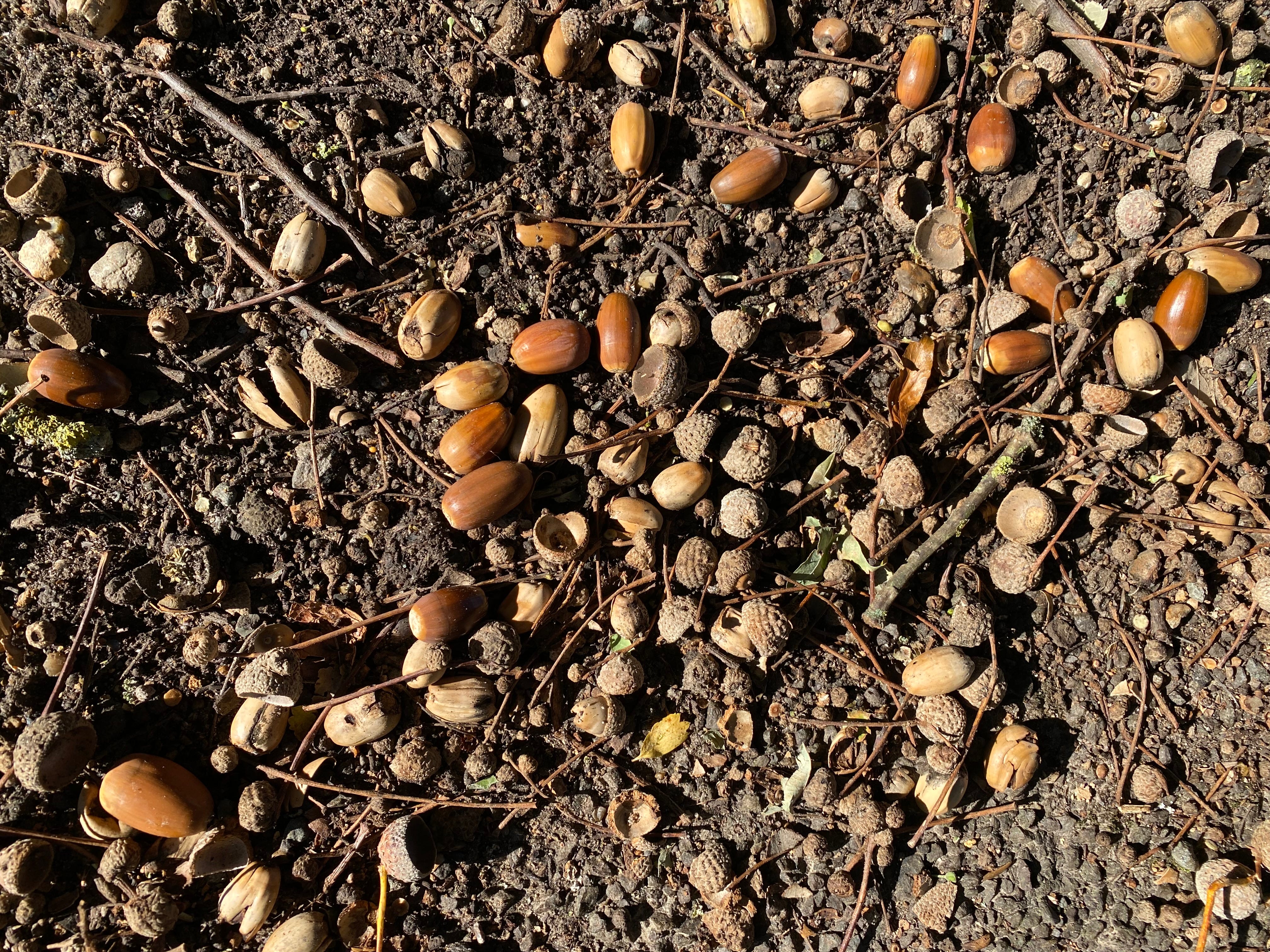
Just a few of the acorns I crunched through, 6 October 2025
In this edition of Bracken & Wrack:
The Scent Of October Sunshine: a walk along the lane
Poetry by Robert Louis Stevenson & John Clare
Held In Balance: the twin fires of Michaelmas-tide
Michaelmas Hazelnut Bake: a forager’s recipe
THE SCENT OF OCTOBER SUNSHINE: a walk along the lane
There’s nothing quite like the scent of October sunshine. It’s the middle of the day, and so warm that I feel overdressed in my leggings and woolly socks. I’m in search of Michael and his Dragon, anything fiery that says Michaelmas-tide.
But it seems that this year I’m too early. Although we’ve had some rain, still the land feels dried up and dusty. The leaves are mostly still green, but the curling brown edges and powdery white-grey mildew give the game away. Even the sycamore, whose uncharacteristically pristine leaves astounded me earlier in the season, has now succumbed to its inevitable black pock-marks, albeit less pitifully than usual.
I’m feeling a little sad. Everything so jaded, and seeing the beige prickles of dead gorse boughs wherever I cast my eyes does little to improve matters. But still, there’s a beauty to be found in the honeyed light. Even at lunchtime there’s a mellow glow about it as it trickles through the bracken fronds that now twist and contort, each day allowing more rays to seep between them.
A flurry of golden oak leaves against the blue sky, and a whole elder tree, shockingly pale yellow, its berry clusters now a silhouetted memory.
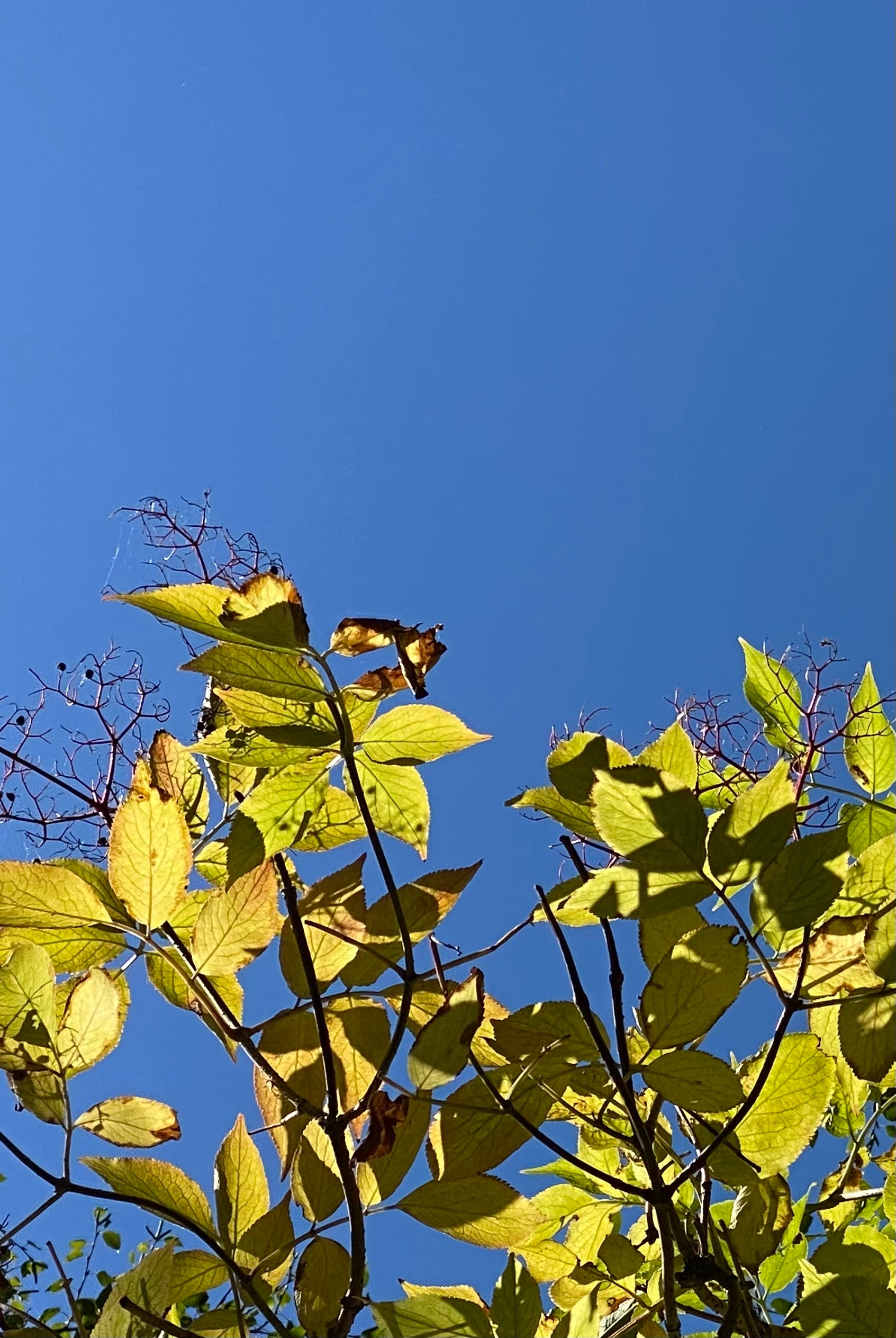
Elder on the corner of the lane, 6 October 2025
The mewing of buzzards, and the sight of one taking off low over our neighbours’ meadow. That same cottage with its front garden full of autumn abundance; dahlias and rudbeckias in jewelled bronze, pink, burnt orange and a velvety red. Crysanths and bulbs to come later, Lyn tells me as we chat over her garden gate on my way home.
How far to go, in search of the sparring duo? The old route, I think, to the stream and back. It really is so long since I’ve peered through bramble, hop vine and reed to catch a glimpse of that sparkle and maybe a dragonfly. Ahh, that would be perfect. But all I spy is a pair of mating damsels and a way down to the water so inhospitably tangled that it’s clear no-one else has taken on my former daily ritual, long neglected, of crouching silently at the water’s edge to see what might reveal itself in the moment.
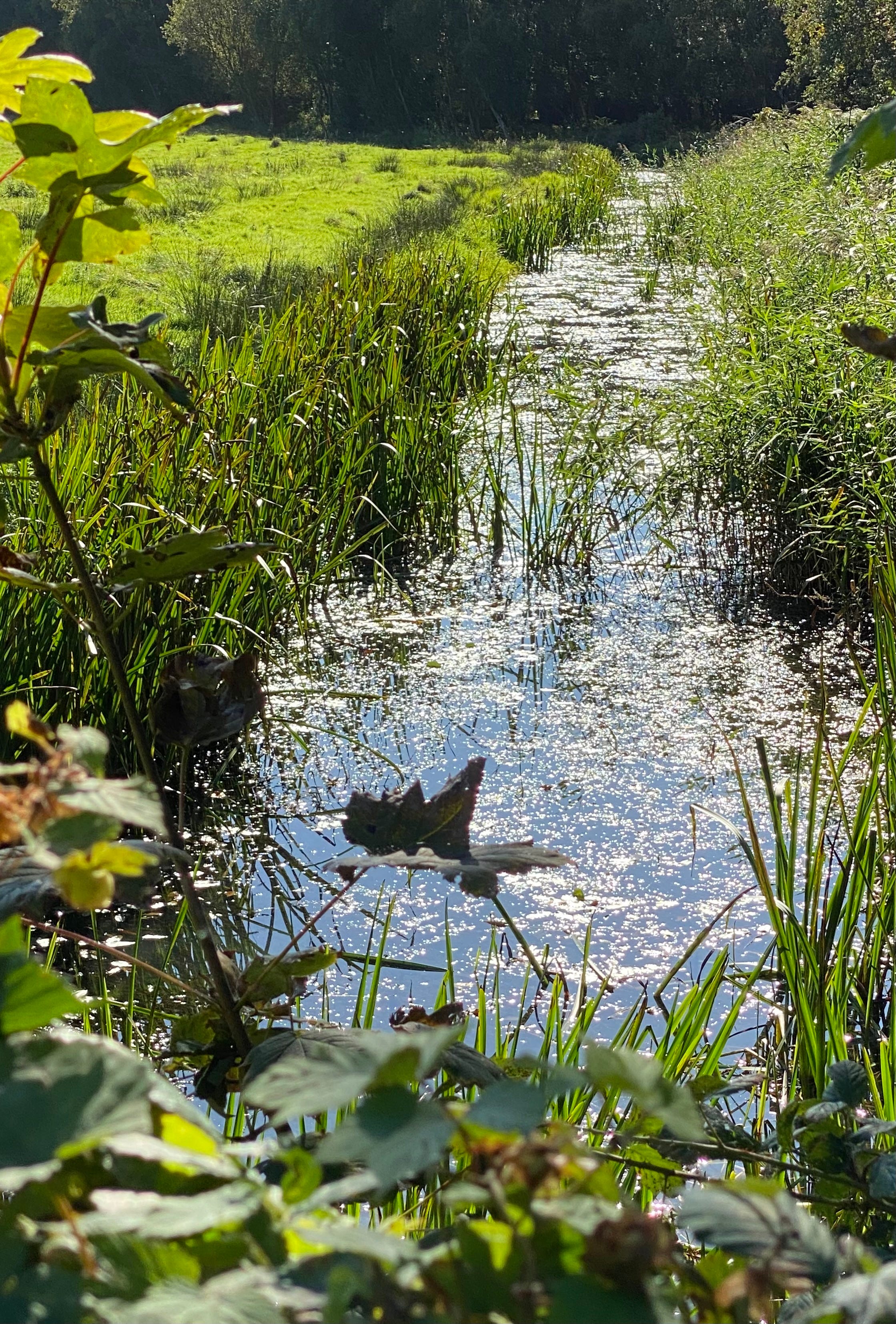
The Otter Stream from the bridge: this is as close as I could get. 6 October 2025
A dark shadow to my left, and a heron flaps lazily low over the water meadow towards the far reaches of the stream. I hold my breath and watch until it disappears.
Turning, at last I catch a glimpse of the fire I’ve come in search of. The Dragon has sent out a flaming tongue, and cast a circle around the fading foliage. A garland of bryony; surely one of autumn’s most magical sights.
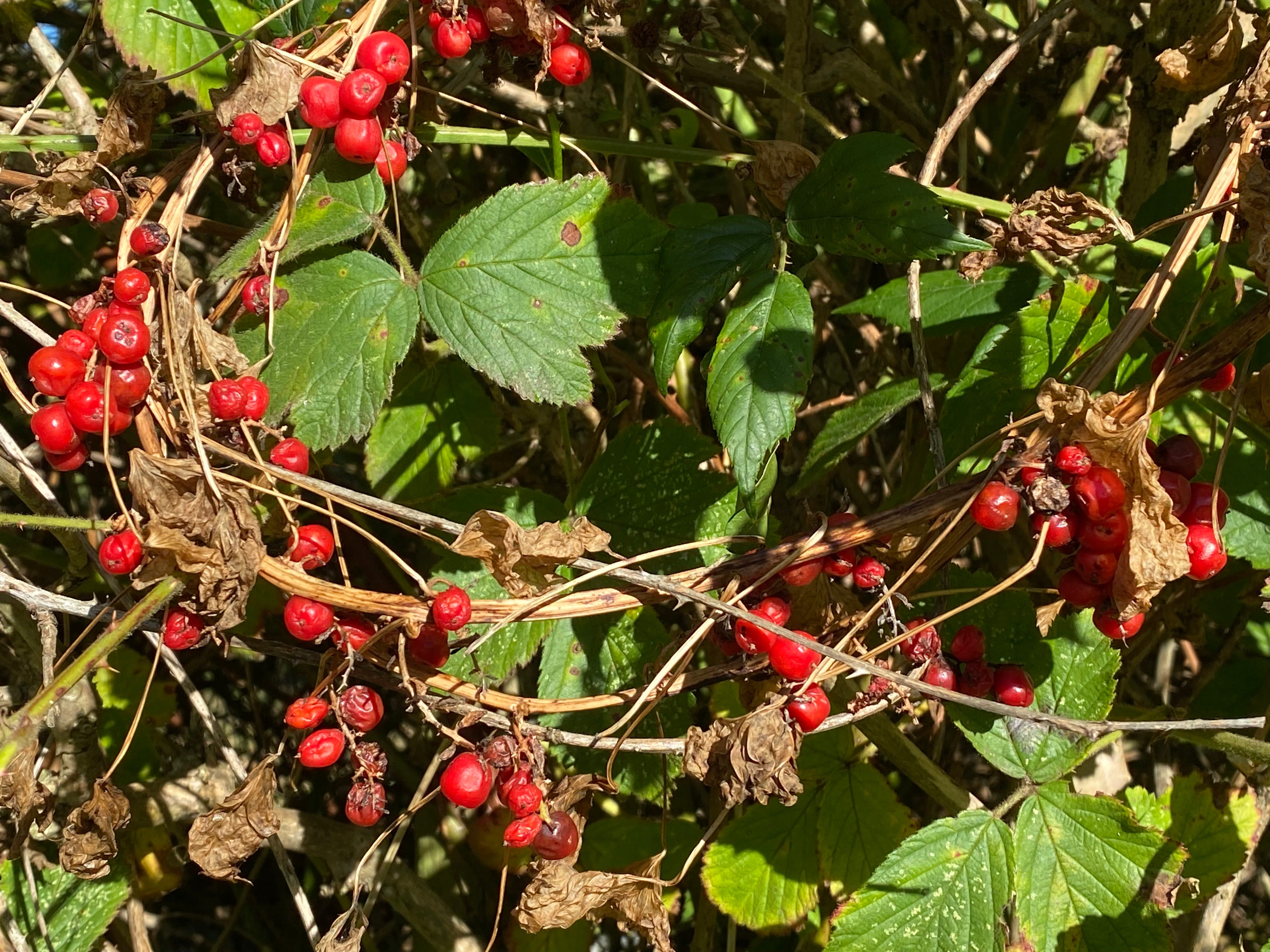
A circlet of bryony close to the stream, 6 October 2025
I’m nearly back at the cottage when it strikes me that I’ve been crunching over acorns, the tarmac visible only where car tyres have worn parallel tracks. A mast year indeed, and who knows what new fiery growth will rise from those bold acorns who send their roots snaking to the dark depths while their shoots pierce the air with all the vigour of St Michael’s sword?
HELD IN BALANCE: the twin fires of Michaelmas
I love the old festival of Michaelmas, one of the four Quarter Days in England along with Lady Day, Midsummer Day, and Christmas Day. A wealth of folklore and tradition has gathered around this time, and it’s easy to take a deep dive into it.
In fact, so much has already been written about this most evocative of Feast Days - High Angels’ Tide in Harvest is one of its alternative names, and how gorgeous is that? - that I find myself needing to search for an alternative angle. Let’s see what happens :-)
I love the very word Michaelmas. Did you know that in some universities the first of the three terms making up the academic year is called Michaelmas term? There’s something very cosy about that, and of course it heralds the hearth fires and hot chocolates of midwinter.
Then there are Michaelmas daisies. Could any colour combination be more breathtaking than theirs of lavender petals crowned with a golden middle? Especially seen against autumn’s fading foliage, bleached stems and browned seed heads, twinkling like scatters of amethyst as the low sunlight rakes across them. Even more dazzling, perhaps, when skies are grey and the spiders have been busy. Then, the clusters explode into starry fireworks, catching the heart and bringing memories of woodsmoke and fairy rings.
The Michaelmas daisies among dead weeds
Bloom for St Michael’s valorous deeds
And seem the last of the flowers that stood
’Til the Feast of St Simon & St Jude.
Traditional
St Simon’s & St Jude’s shared Feast Day is 28 October, so any flowers managing to bloom after that date would be hardy indeed. Especially so, given that the rhyme surely came before the calendar change, meaning that the date of the Feast of Simon & Jude would equate to our 10 November by which time the frosts will have taken their toll.
In her Winters In The World, Eleanor Parker mentions that Bede suggested the pagan Anglo-Saxons called the month in which the winter season began Winterfylleth - a name made up from the words for Winter and Full Moon - because winter began on the full moon of that month. Though Winterfylleth soon fell out of use, the moon closest to the autumn equinox kept its significance long after the end of the Anglo-Saxon era. The 14th century poem Sir Gawain and the Green Knight includes a description of the cycle of the year as it passes from winter through spring and harvest and back to winter again. There, harvest ends with what the poet calls Michaelmas Moon, which must be the full moon closest to Michaelmas. This moon brings with it wynter wage, meaning the first ‘pledge of winter’.
We might think of that as the first chill in the air in an October dusk, or the first time it seems to be getting dark too early, or the first breath of mist in the morning - anything that says that summer has gone and the dark half of the year is coming. In September, amid the bounty of harvest home, it may feel as if summer’s hardly over, but winter’s only one full moon away.
Eleanor Parker, Winters In The World: a journey through the Anglo-Saxon year
I will just say, though, that St Michael can be a tricky one. Those of us who are partial to dragons may find it somewhat distressing to encounter images of the saint stamping triumphantly on a poor creature who is clearly on the point of being dispatched in a most unpleasant manner. One way of reconciling my natural sympathy for the dragon with the themes of Michaelmas is to interpret the scene as the promise that the warmth and light and fire and courage will prevail over the winter and spring will come again. I’ve heard, too, that Steiner schools encourage their pupils to think of dragons as challenging or unwanted habits and imagine themselves with the courage of St Michael to overcome their own.
The British Pilgrimage Trust, whose aim is to encourage ‘pilgrimage’ in the broadest of senses for those of all faiths and none, recently put out a Michaelmas story that offers a slightly different take again.
The writer - who I take to be co-founder Guy Haywood so I shall use his name for ease since the article isn’t credited - suggests that Michael’s fiery spear may be a ray of light, with the dragon representing water. This would be interesting, especially bearing in mind the pagan symbolism of a blade plunged into a chalice. He also lists Michael’s virtues as protection, spiritual strength, love and kindness.
Guy mentions that in medieval times, pilgrimages were often made to sites dedicated to St Michael ‘to connect the physical and spiritual realms, often on hilltops’. I already knew of the Michael Line that’s been shown to stretch across England from St Michael’s Mount in Cornwall to Hopton in Norfolk, running through an extraordinary number of the 816 English churches dedicated to the Archangel. And I was aware that a high proportion of churches dedicated either to Michael alone or to St Michael and All Angels are situated on natural rises, sometimes breathtakingly so.
Think of St Michael’s Mount, or the iconic St Michael’s tower crowning Glastonbury Tor, or the ruined 15th century St Michael’s Chapel perched on Roche Rock near St Austell, in what must be the most dramatic setting imaginable. I have climbed to the last two myself, and can vouch for the fact that they’re a long way up.
Close to the angels, in fact.
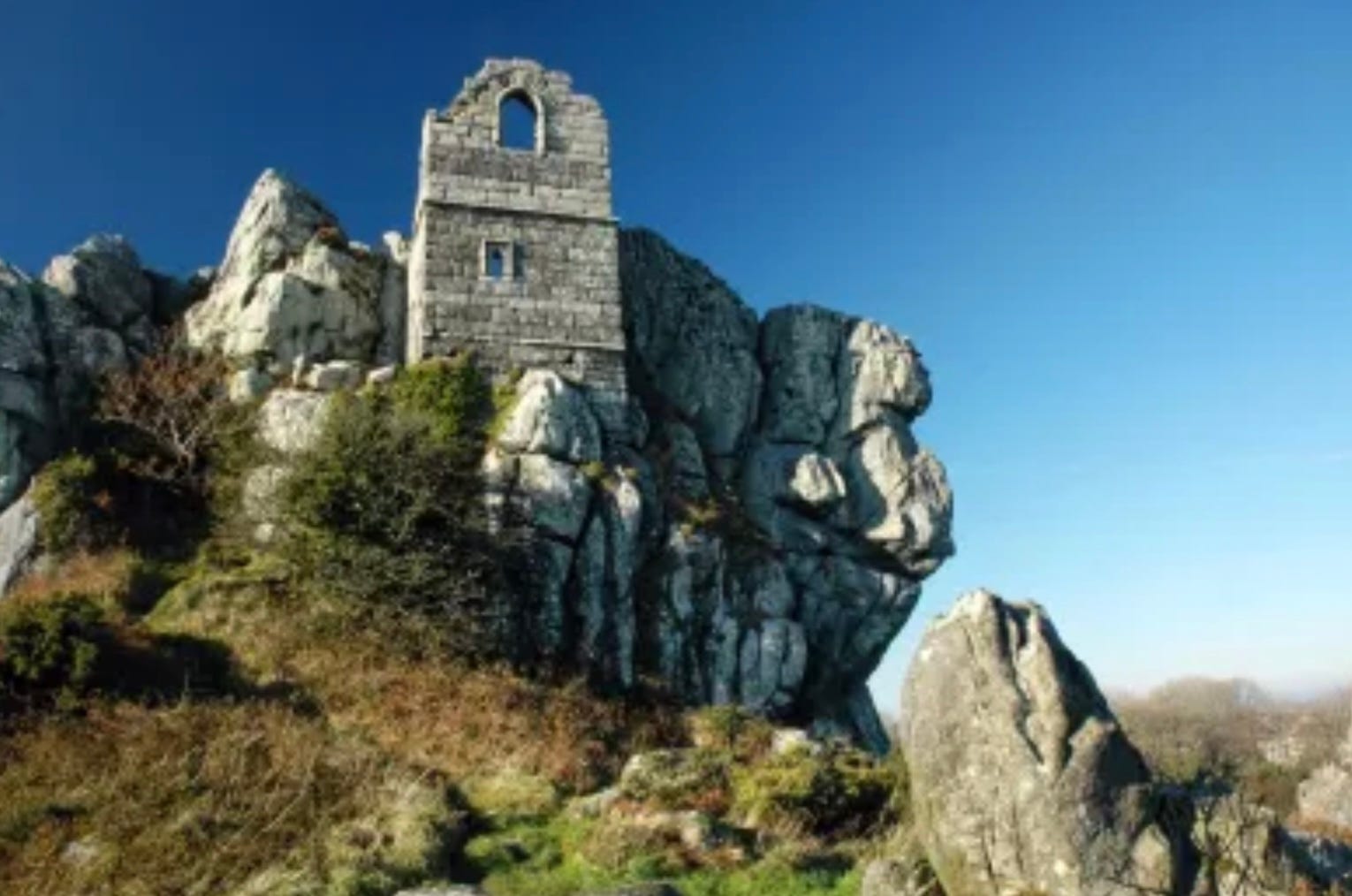
St Michael’s Chapel, Roche Rock, Cornwall (low res screen shot as I didn’t have a photo).
In less extreme topographies like those of Norfolk and Suffolk in the east of England, it’s true that you may not notice the hilltop settings of the Archangel’s strongholds so readily. But they are definitely there, once you take the time to attune yourself to the landscape. As, of course, came naturally to our medieval ancestors. Even more so, perhaps, to our earlier Anglo-Saxon forebears who tiptoed into Christianity via the Celtic/Druidic path.
And some of these local churches are indeed notably elevated, like the one at nearby Swanton Abbot which is dramatic enough in its setting to merit a mention on the church’s own information page:
https://www.exploringnorfolkchurches.org/church/st-michaels-swanton-abbot/
Although the saint is often portrayed in very martial attire, some images bring out his elfin/angelic side and I can’t help finding these especially appealing. Apparently, medieval rood screen paintings of angels with feathery legs or bodies are actually mimicking the angel costumes that actors wore in mystery or mummers’ plays. The feathers symbolised the otherworldly nature of these beings in contrast with the other more roundly human characters in the plays. Barton Turf and Ranworth churches in Norfolk both have lovely depictions of a very fey St Michael with rather otherworldly bare feet.
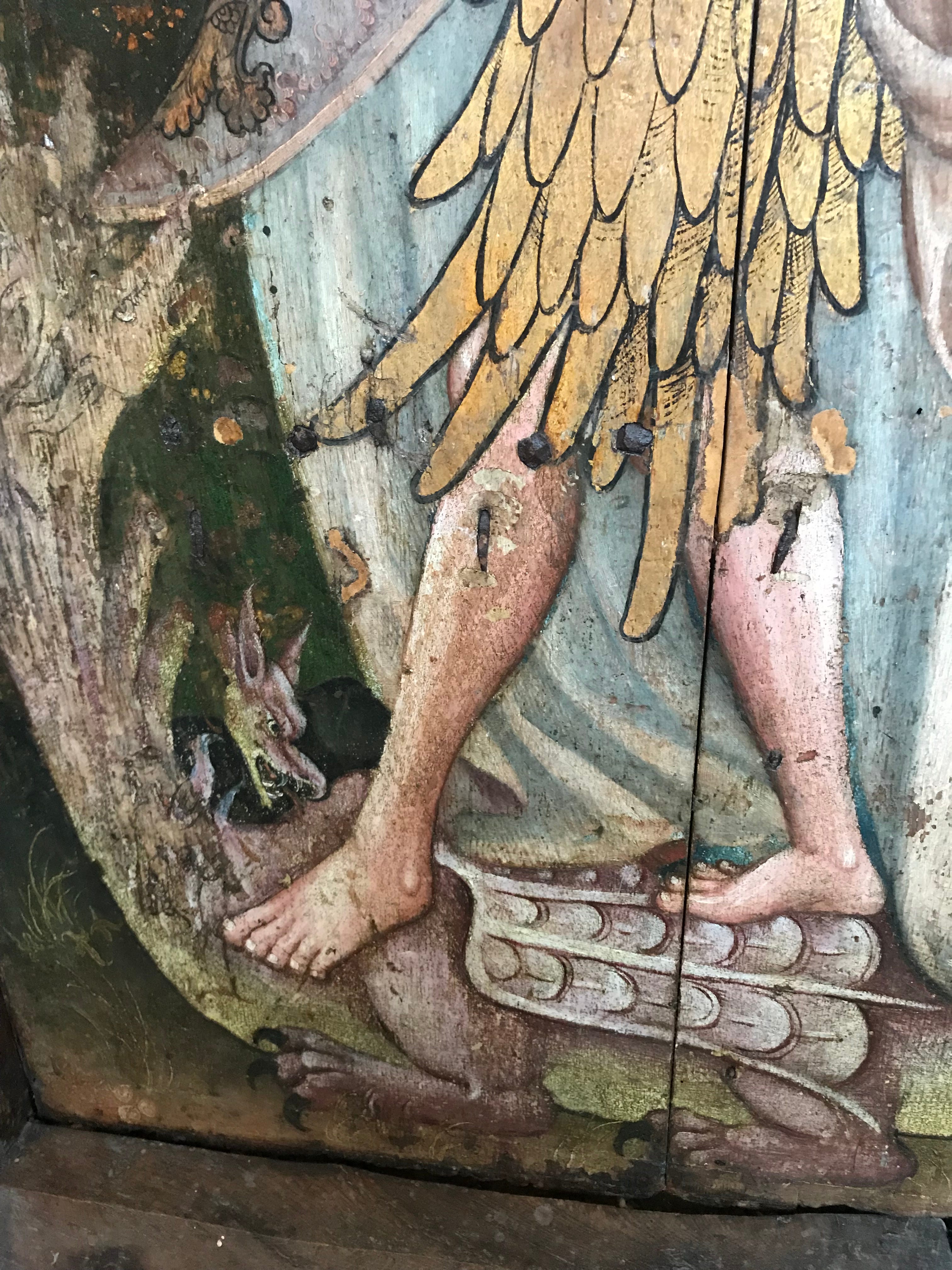
Delicate toes he may have, but Michael has his scaly counterpart pinned under them, and still there’s the question of the Dragon’s part in all of this. Did medieval painters and carvers see dragons as out-and-out bad guys or did they actually have a soft spot for them? There’s no clear answer. It seems that the Dragon’s role was to be grappled with before being vanquished by our conquering hero, yet it’s easy to find comical or even cute portraits of them scattered through our ancient buildings.
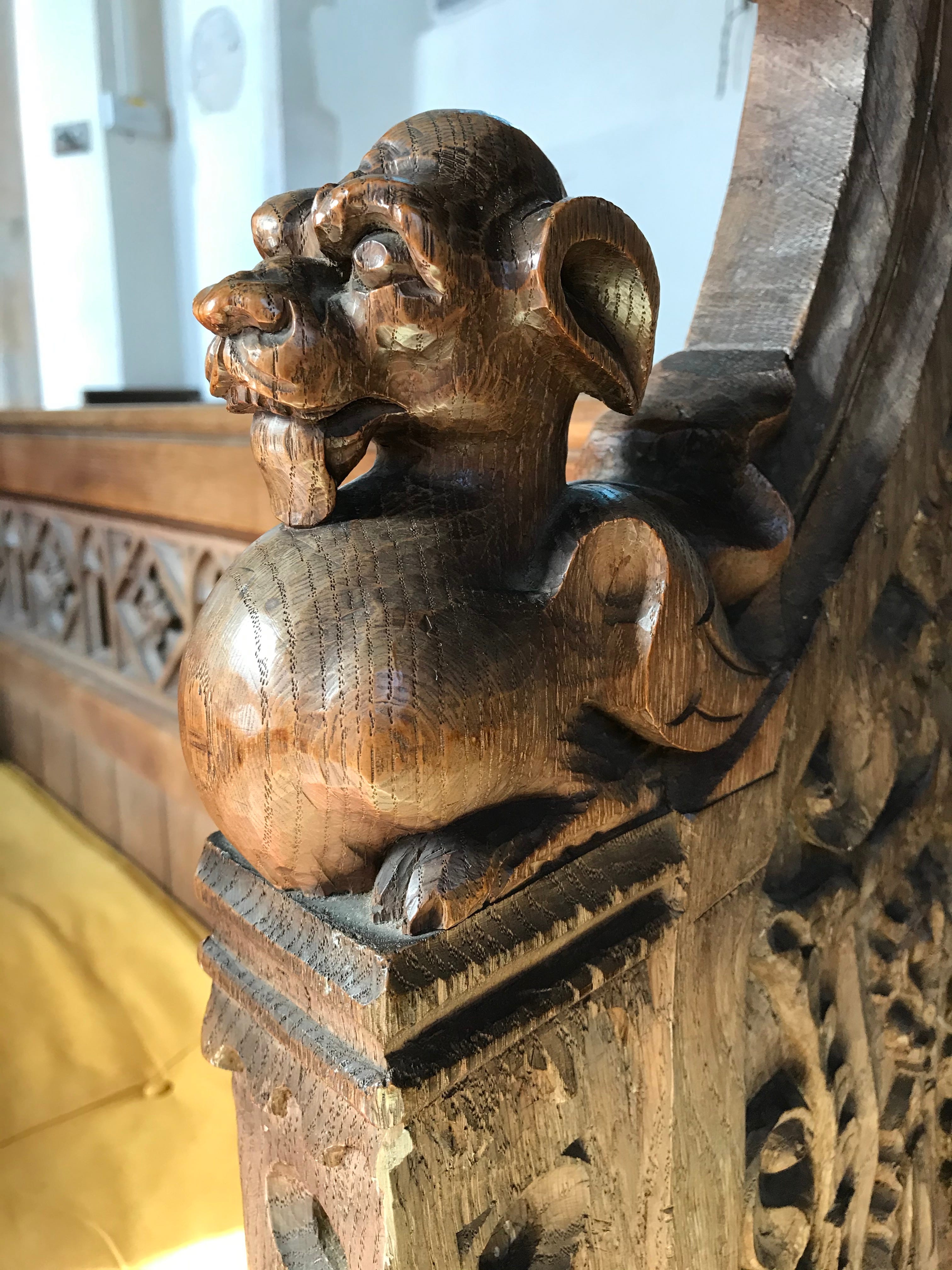
Curiously comical dragon in Horning church, Norfolk
Perhaps the most ambivalent depiction is that of the tiny dragon emerging from St John the Evangelist’s goblet seen on many an ancient rood screen. Our heads may tell us that this little creature symbolises the cup of poison taken by the saint, yet I can’t help thinking ‘aahh, how sweet’.
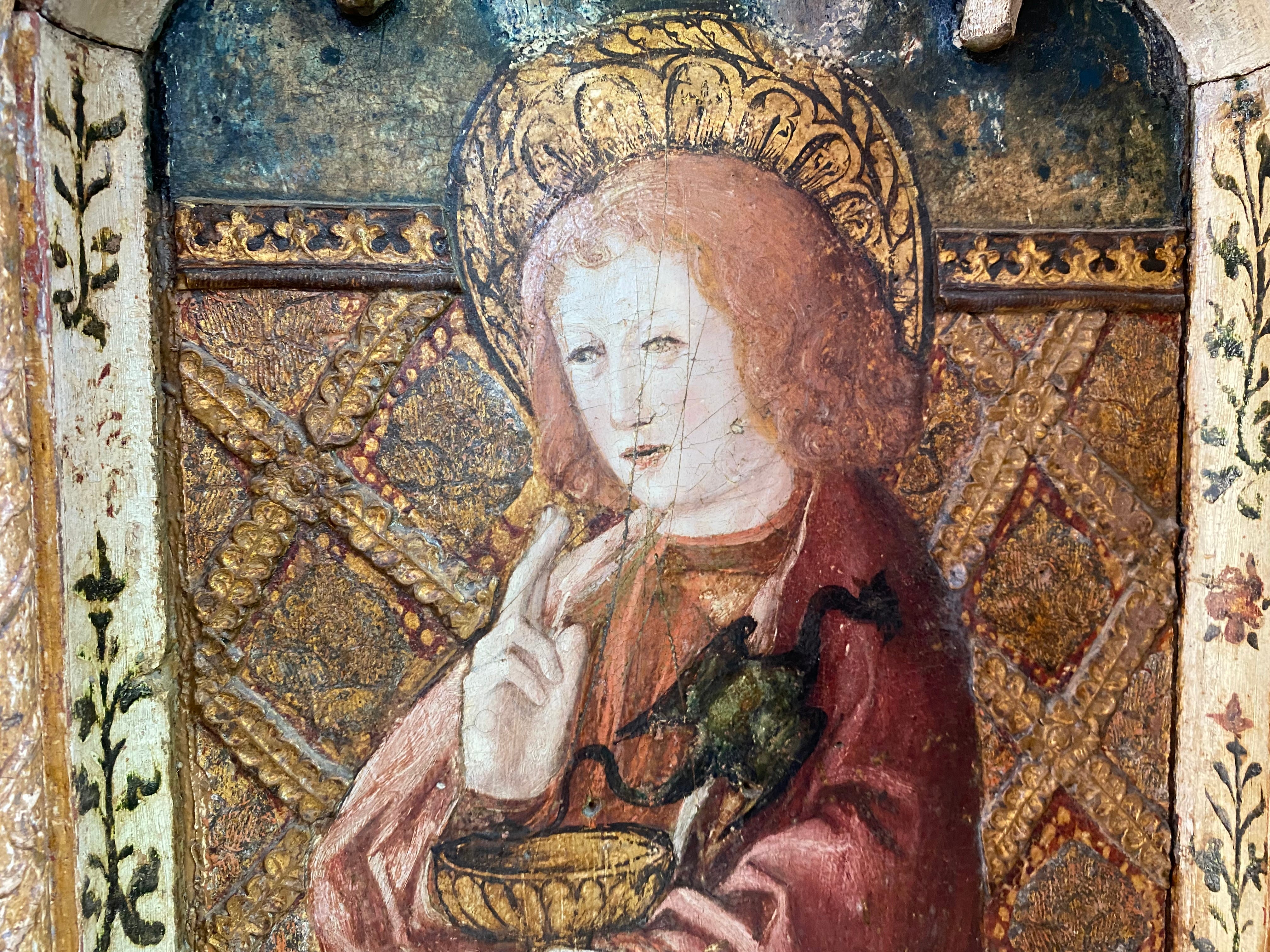
St John with his perfectly-formed tiny dragon, Worstead church, Norfolk
Another possible way of looking at the Dragon brings us back to the Michael Line, which as an invisible track through the landscape connects with the concept of ley lines. Some people think of these leys as currents of dragon energy, snaking under the land, crossing and re-crossing in places of power. And when you come across an old tree whose tangled roots seem to fairly slither and slide into the ground, you can well believe it.
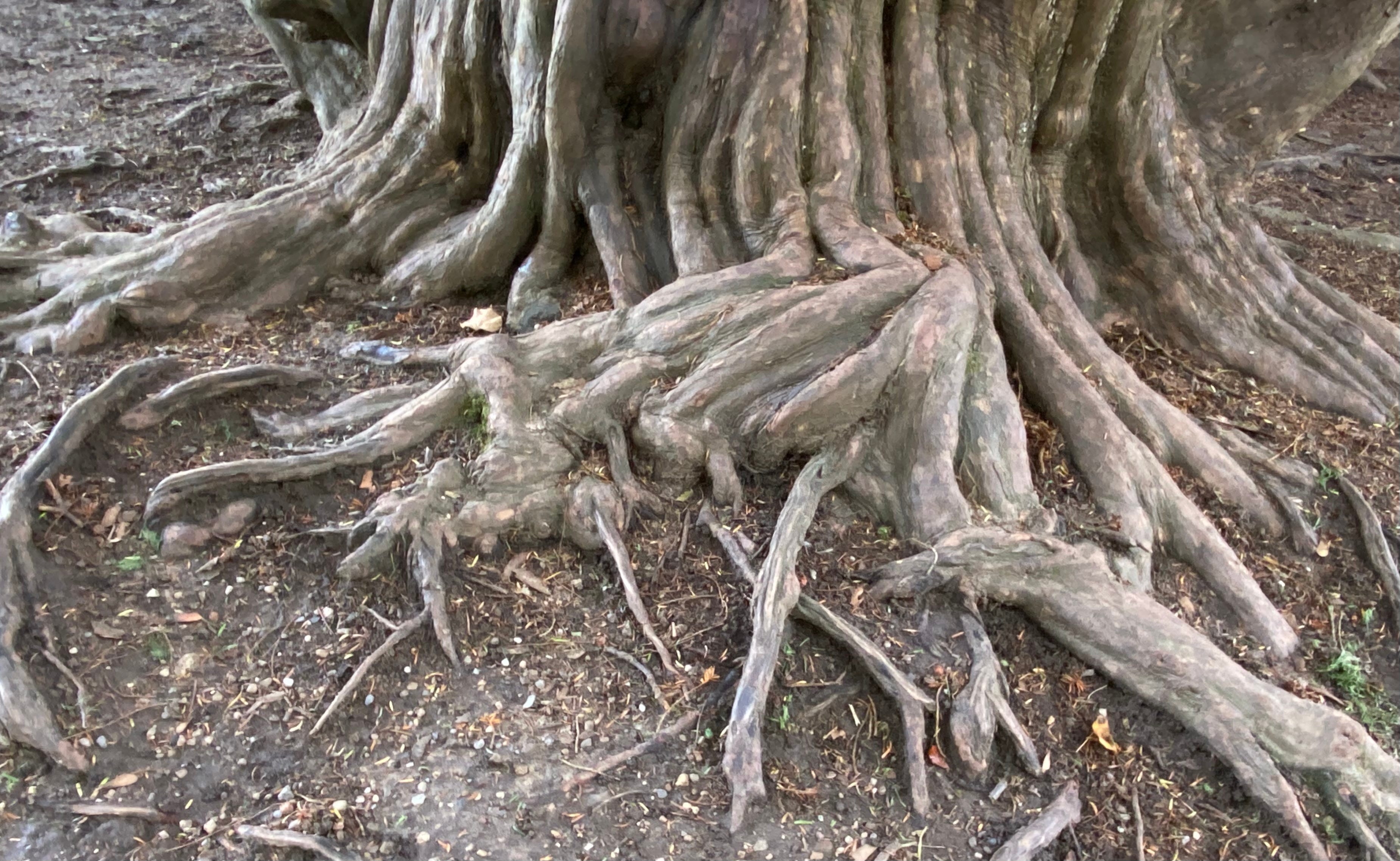
Dragon-y roots slipping into the ground at Fountains Abbey, Yorkshire, 27 September 2025
Rather neatly, that brings the two into relation again; in fact into balance. And balance is another of St Michael’s keywords. After all, he holds the scales that measure the weight of souls, and his Feast Day lies soon after the equinox when day and night are equal.
Perhaps what we are witnessing is another version of that old, old story of deep magic. St Michael’s fiery blade may subdue the Dragon for a while, telling us that winter will not last forever and the light will return. But the Dragon holds their own fire, forging unseen paths and spreading wild energies through the land. Each year at Michaelmas, the cycle replays itself and we have an opportunity to ride on its wave, absorbing both virtues as swallows gather on the wires and the first skeins of wild geese cry overhead.
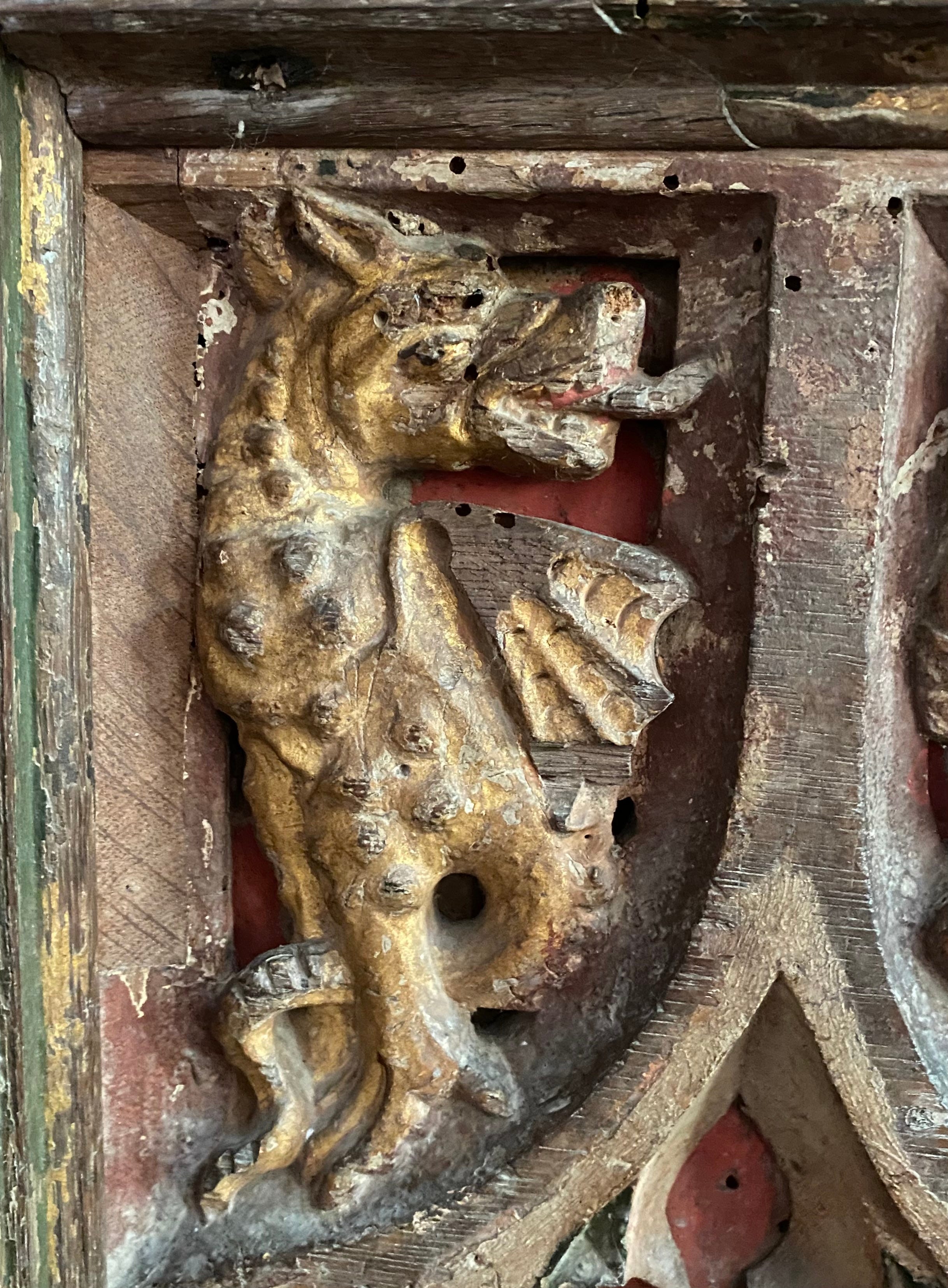
The Dragon shows his flaming tongue on the rood screen at Suffield church, Norfolk
The wild wood music from the lonely dell,
Where merry Gipseys o’er their raptures dwell,
Haunting each common’s wild and lonely nook,
Where hedges run as crooked as the brook,
Shielding their camps beneath some spreading oak,
And but discovered by the curling smoke
Puffing, and peeping up, as wills the breeze,
Between the branches of the coloured trees: —
Such are the pictures that October yields,
To please the poet as he walks the fields
John Clare, from ‘October’ in The Shepherd’s Calendar
MICHAELMAS HAZELNUT BAKE: a forager’s recipe
No travelling gypsy would have let an abundant wild hazelnut crop go to waste. Neither would the people who trod this land in prehistoric times. Indeed, mysterious rings of carefully-curated pits include some that must once have been filled to the brim with the empty nutshells.
And with winter fast approaching, bringing with it a shortage of variety in wild diets, this frilly-edged harvest came at exactly the right moment. Whether or not the gatherers were aware of the finer points of nutritional value, it’s true to say that hazelnuts are special.
Like all nuts, hazels are packed with vitamins, minerals, antioxidants and phytochemicals that are beneficial to overall health. Incredibly, the regular consumption of nuts has been shown to contribute to heart health, to reduce mortality and the risk of developing type 2 diabetes, to aid weight management, to reduce the risk of some cancers, to improve cognitive function, attention capacity and sperm quality, to reduce depression and simply to promote overall good health.
Specifically, they are one of one of the highest-ranking nuts when it comes to fibre, folate and vitamin E, and are a source of copper, magnesium, manganese, thiamin, niacin and omega-3. What’s more, they are naturally low in sugar and sodium.
Well, there’s no arguing with that! And that’s all without the ‘small’ detail that hazelnuts are delicious, especially roasted.
And so we move to our recipe. It’s a simple one, which I have adapted to make vegan. Of course, you don’t have to do that, and I’ve suggested (more authentic) alternatives.
The original is a Romani/Traveller recipe and makes use of a glut of hazelnuts. I’ve never seen that many in any single year but then, much as I enjoy a wander, I’m not on the road all the time.
Like me, you may need to buy your hazelnuts from a shop and they are expensive, so I’ve cut down the quantities. Of course if you happen to have more nuts and potatoes than you know what to do with, feel free to multiply the measurements given here.
Speaking of potatoes - which are always a relatively cheap food and their use here may justify the cost of the hazelnuts ;-) - did you know that one of the Romani names for October is Putatengero, Month of the Potatoes? Traditionally, October was the final month of the big harvesting jobs for Traveller families with the picking up of potatoes. This was a major task that would see them into the winter. As Lia Leendertz says in her Almanac for 2021, it was hard work, bending all day and then lifting the heavy loads of potatoes, but it was lucrative. Carried out as the days became increasingly cool and the leaves started to turn, the morning’s rekindled fire must have been especially welcome to see off the night’s chill and mists.
This warming recipe might help, too.
300g cooked potato
300g shelled hazelnuts
a little plant-based (or dairy) milk
1 tbsp chia seeds or milled flax seeds (or an egg)
You may like to add spices or seasoning to taste but these are not in the original recipe.
If you’re making this vegan, first place the chia seeds or milled flax seed in a small bowl and mix with about 4 tbsp water. Leave on one side to thicken for 10 minutes.
Blitz the hazelnuts, leaving them a little chunky, or place in a plastic bag and crush with a rolling pin if you don’t have a food processor (the travelling folk probably didn’t!).
Mash the potatoes, incorporating the flax or chia ‘egg’ if you’ve gone for this option. Mix in the hazelnuts, the beaten egg if used (going carefully - you may not need it all) and a dash of milk if necessary.
Form into small balls and place on a well-greased baking sheet. These can be baked in a Dutch oven over a fire, or in a regular oven, until brown. Baste with hot fat now and then.
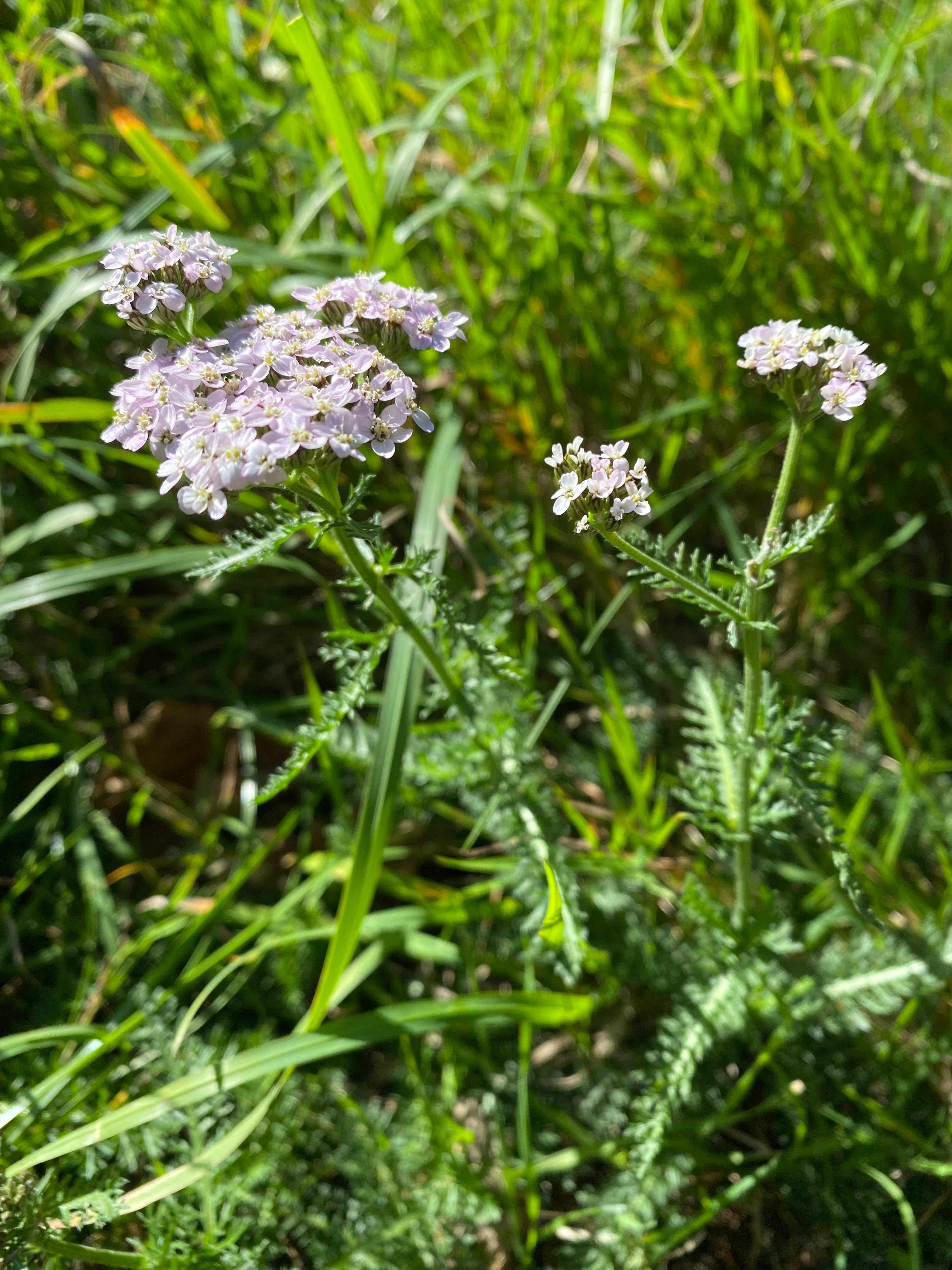
Yarrow: a protective and healing ‘warrior’ herb keeping guard under the hedgerow. It has so many uses and is still flowering strongly now at Michaelmas-tide, 6 October 2025
Until next time.
With love, Imogen x
Your writing is inspirational. Such a beautiful autumnal blanket you have woven for us. I feel truly blessed to have read it. Maybe one day I will write something so beautifully crafted as this.
Fascinating and beautifully written. You should consider putting together a collection of your articles for publication.