The Dew Dipped Year
maudlinwort & honeyed hearts

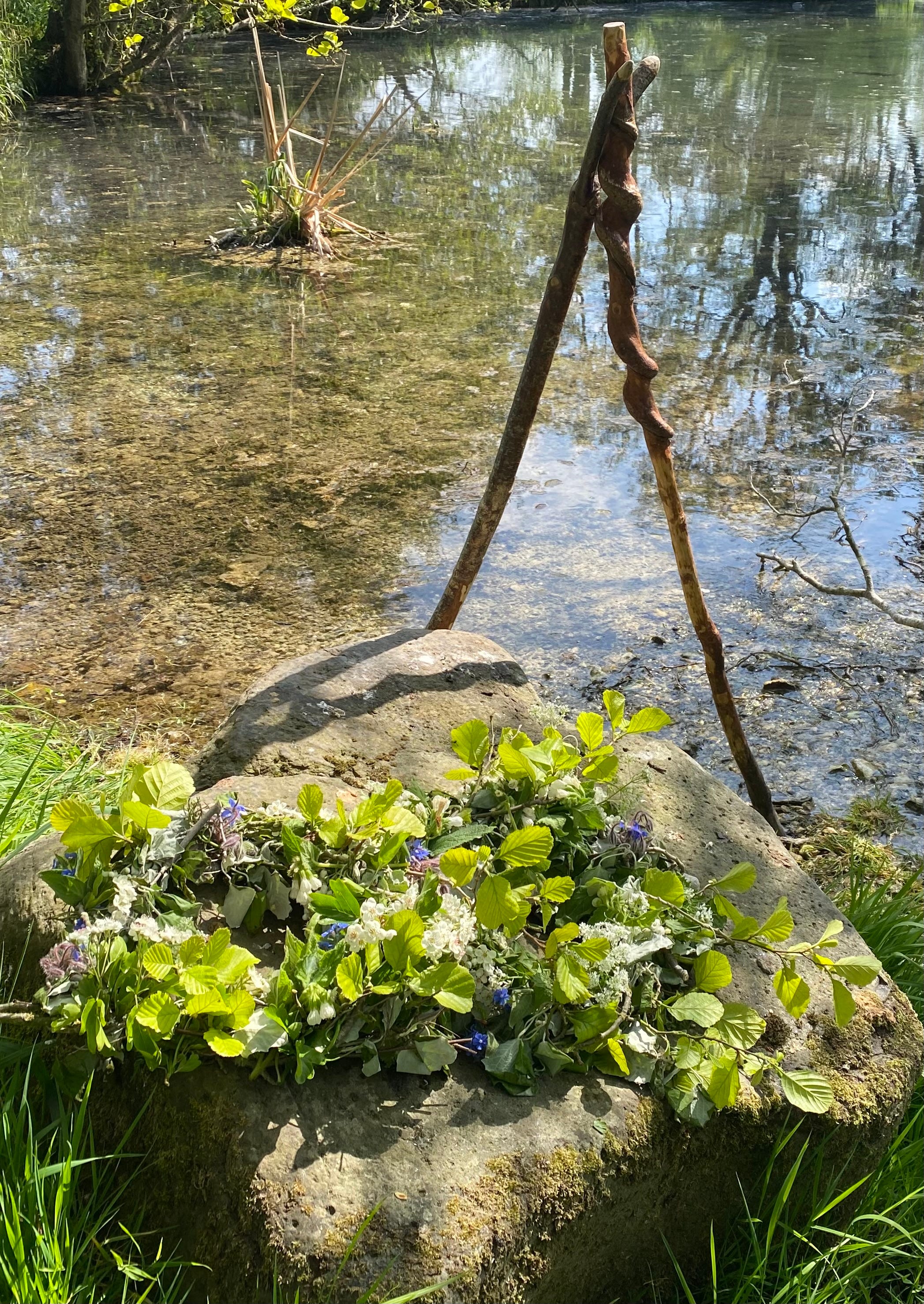
Offering our May Crowns to the Ladywell behind St Mary’s Church at Sedgeford, Norfolk. The circlets were fashioned from birch and aspen twigs found in the village hall car park opposite our cottage. Everything else was foraged from close to the beautiful chalk spring that is the Ladywell: cow parsley, mayblossom, borage, Chinese forget-me-not, comfrey and the vivid yellow-green of young alder leaves. 2 May 2026
Hello, and welcome to the first edition of Bracken & Wrack since the huge upheaval of moving to a tiny cottage just a couple of miles from the old one! I have to say that the chaos is far from over, but with the New Moon on its way it feels like high time to resume my sharing of these seasonal updates with you all.
As I say, the new cottage is very close to where I lived before, meaning that the landscapes we’ll now be travelling together overlap quite a bit with the old ones. Crow Wood, the Otter Stream and the Alder Carr aren’t far away, but also there are myriad new footpaths, woods, stream edges and ancient landmarks to explore. I suppose it’s most accurate to say that the new cottage is on the other side of an imaginary circle with the medieval church of Crostwight at its centre. You may remember that church with its beautiful early wall paintings. These include a magnificent St Christopher and Christ Child opposite the south door, perfectly positioned for a protective glimpse before setting out on any perilous journey.
But another medieval church is actually far closer to me now. So close, in fact, that the landing window frames its tower perfectly when the leaves are off the trees as they were when I first viewed the cottage. It’s a hilltop church - though not dedicated to St Michael as you might expect - and it’s become something of a ritual to take my morning cafetiere up along the field edge to perch with my notepad among the wildflowers in the graveyard most mornings.
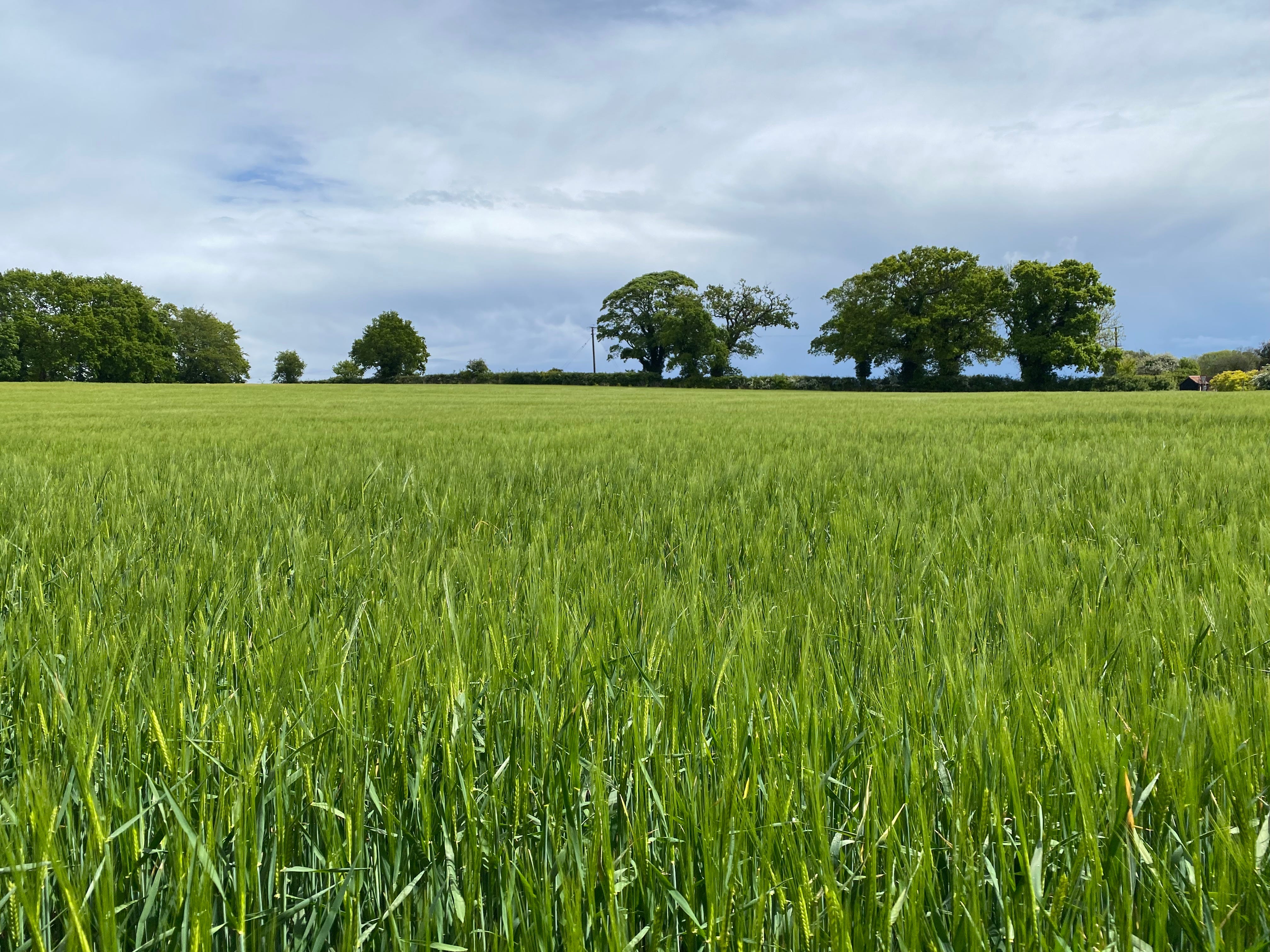
Walking along the field edge towards the churchyard, it’s impossible not to notice the waving heads of barley that have shot up in leaps and bounds since our arrival less than a month ago. 13 May 2026
Speaking of wildflowers, this churchyard has been singled out by Norfolk Wildlife Trust as being in the top three when it comes to nature conservation and the preservation of uncommon wild plants. This is readily explained when you remember that while ubiquitous species like nettle, plantain, dandelion and alexanders thrive even in aggressively cultivated agricultural landscapes, other more delicate ones do better where they are literally never disturbed and certainly not sprayed.
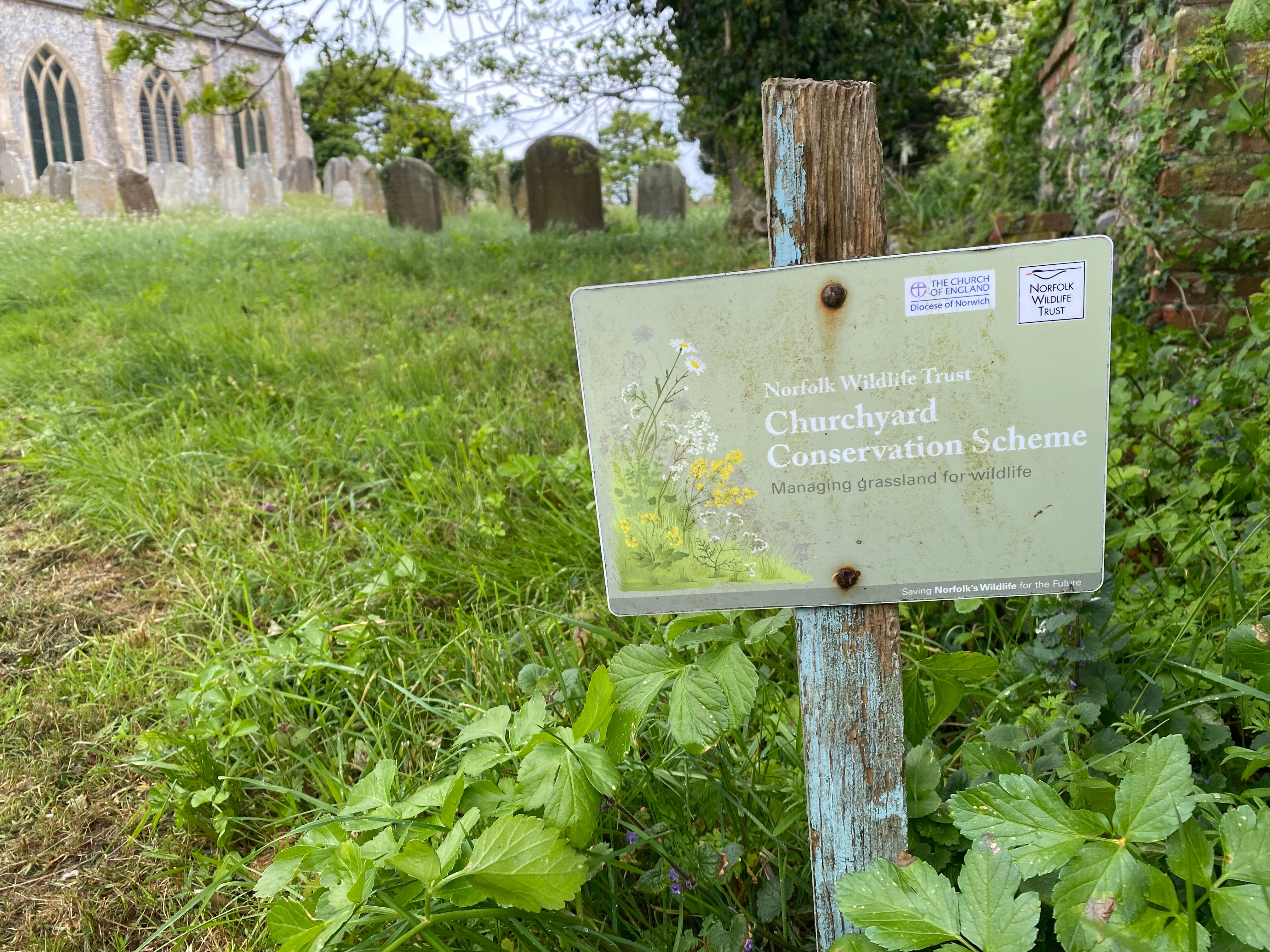
Through the gate and into the graveyard of the hilltop church. 13 May 2026
My new plan for Bracken & Wrack’s twice moon-thly newsletters is to keep them short and sweet with nature updates, plenty of seasonal photography, a little resonant poetry and perhaps just one stand-alone story per issue. Sometimes this will lead to a recipe or another suggestion for a seasonally appropriate ‘make’. I hope this fresh structure will help to keep the format lively and digestible, and I have some ideas too for series’ that might run through several issues. Of course, in addition I’m always open to suggestions for topics you’d like to see explored or brought to the fore.
Meanwhile, in this edition of Bracken & Wrack you’ll find:
Tales From The Churchyard: Oxeye Daisy
Poetry by John Clare
Morris Dancing & Beltane Fires: Seasonal photographs
Swallowhead Spring: A watery story for May
A Poem in Pieces: Part 1 - Hobnail Tales
A new series that I would like to begin today will look at the folklore, magic and mystery of a single species of churchyard wild flower that catches my eye around each New Moon. And at each Full Moon we’ll explore one of the other curiosities of this gaunt stone angel atop its hill. I thought we could call the series Tales from the Churchyard. Let’s begin now.
TALES FROM THE CHURCHYARD: Oxeye Daisy
Arriving in the churchyard between sudden sharp showers and surveying the scene (which changes every single time) there was no doubt in my mind as to which flower should take the spotlight this Moon. The recent combination of rain and sun has encouraged the opening of hundreds of the starry blooms of the oxeye daisy. Standing as they do above the vetches and buttercups, the exposed position of this church allows a brisk north-easterly to sweep across, setting their golden middles dancing like scattered coins that twist and glint as they fall to earth.
Once, I researched the stories around lawn daisies for Bracken & Wrack’s Between the Moons friends* but I guessed that their more stately cousins might have attracted lore of their own. And this is definitely the case.
Dedicated by the Romans to Diana, their hunter-goddess of the moon, this flower was re-dedicated by Christians to Mary Magdalen. For this reason it was sometimes known as ‘maudlinwort’ (a name I had never before come across but really like!).
A perennial plant, oxeye daisy flowers from May to July, which makes sense as more of the brilliant white blooms are opening each day now. It spreads quickly, as you can witness in the churchyard, by seed (each flower yields up to 1300 seeds!) and also by means of its creeping rhizomes. Incredibly, and oddly precisely, I read that the seeds can remain dormant for up to 39 years before springing to life. Oxeye daisies are one of the most important plants for pollinators in the UK, especially for solitary bees like bumble and mason bees.
In folk cures, the plant was crushed and its juice used to repel fleas. Also the young leaves and flowers were drunk as tea to relieve stomach ulcers and as a diuretic, and to relax the bronchial passages after a bout of flu or a bad cold. In the 16th and 17th century oxeye daisies were crushed, made into an ointment and applied to wounds, or infused in beer as a cure for jaundice. (These uses aren’t recommended today: do consult a qualified herbalist before trying old remedies).
Folklore attached to the oxeye daisy (Leucanthemum vulgare) is a little confused as some of it clearly relates to the other plant we call a daisy - the lawn daisy, whose Latin name is Bellis perennis. One piece of lore suggests that each oxeye daisy flower is the spirit of a child who has died, and that they have been scattered over the fields to comfort grieving parents. Another is that wearing a daisy flower will attract love to you.
Again, some the common names for the daisy may relate to the smaller species, but those that seem likely to relate to Leucanthemum include bruisewort, Baldur’s brow, bullseye, butter daisy, dog daisy, dun (thunder?) daisy, field daisy, goldens, marguerite, maudlin daisy, maudlinwort, moon daisy, moon flower, moon-penny, St John’s flower (it does flower around midsummer) and thunder flower.
Meanwhile the graveyard is a sea of silver and gold, precious tokens of the spirits of those who lie beneath.
* If you’d like to read The Day’s Eye and access the rest of the Between the Moons archive, as well as receiving new exclusive posts, please consider upgrading your subscription. It really helps, and there are lots of new ideas in the pipeline.
(Press Play to hear an audio version of this extract from ‘May’ by John Clare)
How lovly now are lanes and balks,
For toils and lovers unday walks
The daisey and the buttercup
For which the laughing children stoop
A hundred times throughout the day,
In their rude ramping summer play —So thickly now the pasture crowds,
In a gold and silver sheeted clouds,
As if the drops of April showers
Had woo’d the sun, and swoond to flowers.
The brook resumes its summer dresses,
Purling neath grass and water-cresses,
And mint and flagleaf, swording high
Their blooms to the unheeding eye
And taper bowbent hanging rushes
And horse tail childerns bottle brushes
And summer tracks about its brink
Is fresh again where cattle drink
And on its sunny bank the swain
Stretches his idle length again
Soon as the sun forgets the day
The moon looks down on the lovly may …
John Clare, ‘May’ (extract), The Shepherd’s Calendar
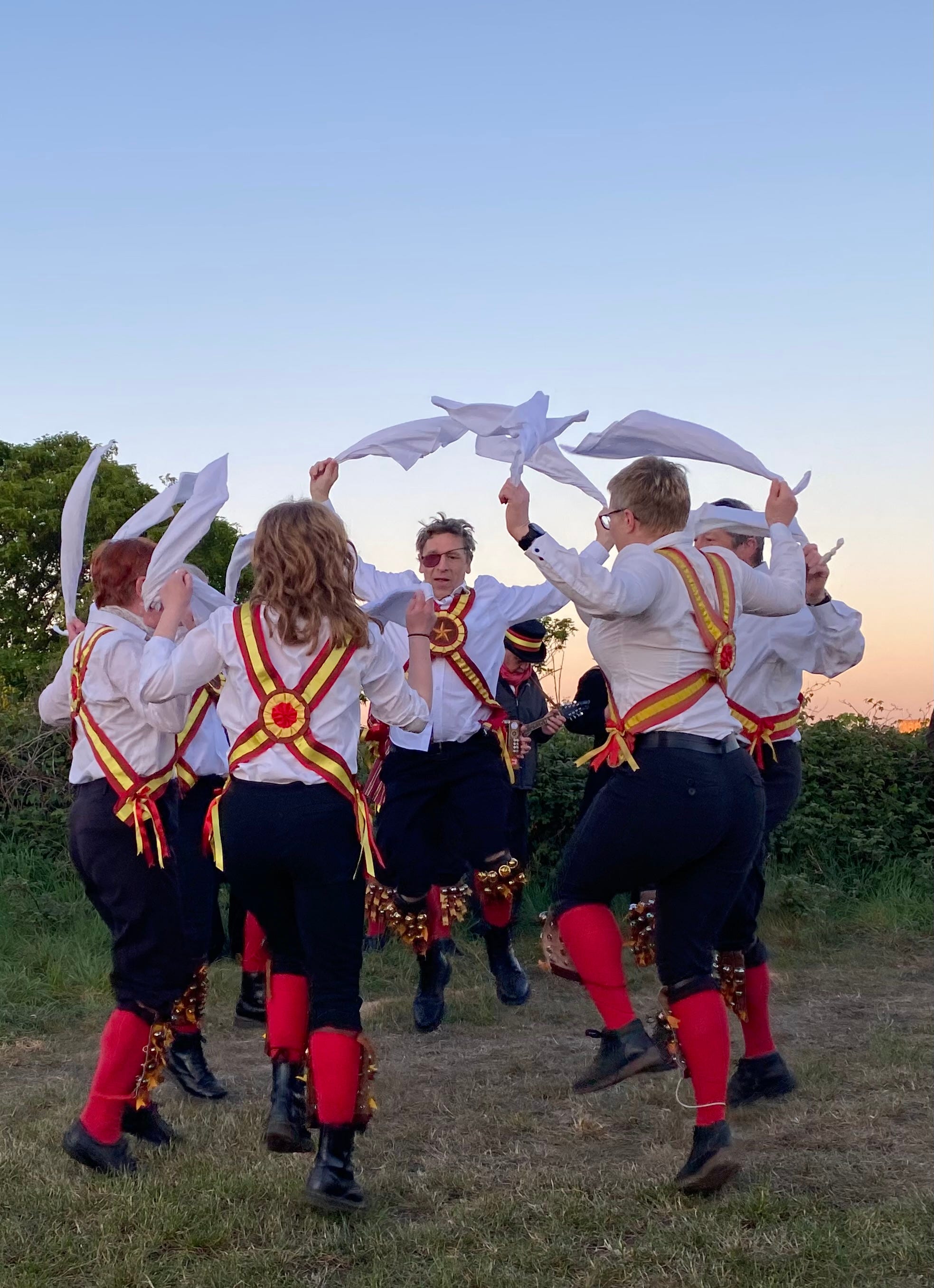
Morris dancing by Golden Star Morris as the sun rose on St James’ Hill, Norwich at 5am on 1 May 2026.
SWALLOWHEAD SPRING: a watery story for May
Across the wet grass of the field, well it’s all wet, it’s raining. Quite a fine drizzle and I am following you so I don’t really notice those last moments before we reach the stream. I think there are cows. It always pays to be mindful of them.
So here we are and it’s raining and the stream is flowing really quite fast and the stepping stones - boulders I should say - are wet, green and slippery. Some of them have flattish tops but others are angled and it’s all too easy to imagine the slipping of soles.
Can we possibly cross? The spring itself is on the other side so there is no other way. It’s the heavy back packs that are the issue. Try to cross wearing them and overbalance and you would be in the water, no question. And it’s not so much the getting wet as the fact that the stones are hard and sharp and we have West Kennet long barrow to aim for afterwards. The jewel we’ve had twinkling in our minds’ eye from the start of the walk.
Wet sloppy grass flopping. Buttercups. The gaze of cows. The water’s edge seething, swirling, flowing, eddying. Unravelling around the stones, then plaiting again. A friendship bracelet. Green wet rocks almost touching each other. It doesn’t look so difficult, except that they are slippy and one or two come to a point which means they will be unforgiving of the slightest error.
You say you will take your bag over, come back for mine, then once more for your camera and me. Every step is a page turned over in a book, intently read. The last stone is the hardest, each time a wobble and my heart is in my mouth but you make it.
I clamber over on my own, reluctant to take your hand for fear of pulling us both over the edge. I’m on hands and feet. All fours feels best as the water races on either side. I’m not giving up now. West Kennet has been saved for this moment, this full day of journeying in the land of Avebury, Silbury Hill and the White Horse.
Today we awoke much closer to Avebury’s giant circle of stones than we could ever have imagined and we know that when night falls we will lie again in this place of trembling vibration, even though we don’t yet know exactly where we will end up pitching our tent.
If we knew that we would be doggedly walking on and on through the rain with aching shoulders and feet, eschewing unsuitable fields of cows until reaching and camping on Woden’s Dyke the excitement might have been even higher. As it is, I’m almost within sight of this Neolithic monument I’ve heard named so many times. A sense of the sublime. I shiver.
And here we are at the entrance in a light drizzle. Leaving our gifts at the spring, we’d followed the track between ordered rows of crops with their fiercely weed-killed edges. Beyond, the barrow had loomed wild and massive. How ant-like the farmworker wielding his spray, how ineffectual the attempt to trample nature into submission.
Now, stepping between slabs into an angled walkway higher than my head only whips up the mystery, as swallows swoop in and out around our heads. We enter darkness. A house of death and also of life. The ancestors knew a thing or two.
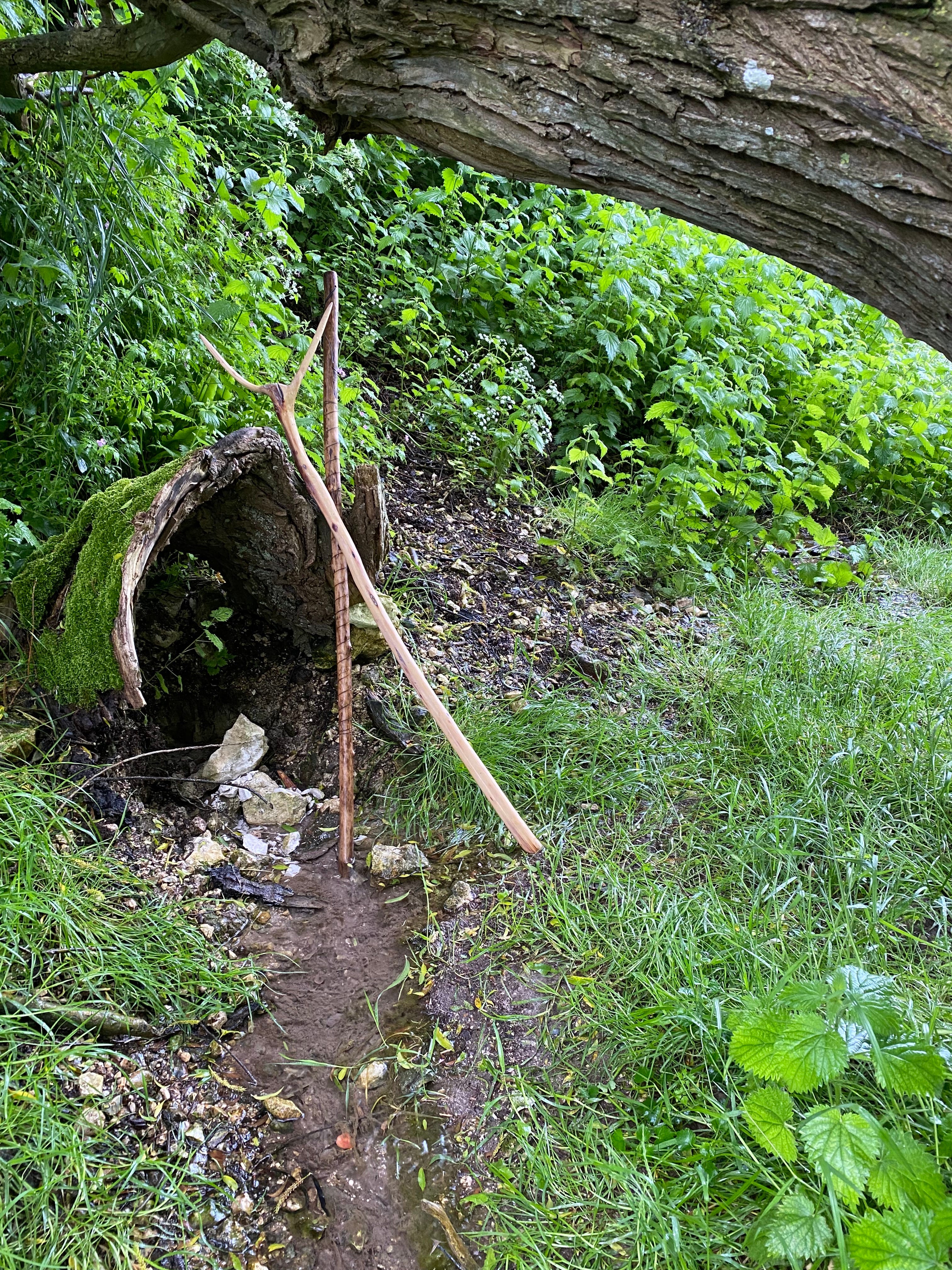
On the other side: Swallowhead Spring near West Kennet, Wiltshire, 26 May 2024
A POEM IN PIECES: Part 1 - Hobnail Tales
Dylan Thomas is not an easy poet. When I was younger I never really got to know his work, and still just hover around the edges. But then, a year or two ago, the magic of his words - the enchantment of the spells they cast rather than of any real understanding of their meaning - burst open for me. I realised I could just bathe in the power and mystery of those words and their patterns rather than needing to strive for a coherent narrative or critical analysis of the poem as a whole. None of that mattered. I suppose it’s equivalent to the way medieval churchgoers responded to the magic of Latin liturgy for its own sake. The shape and the feel of the phrases and the vibration of the chanted sounds were enough. So, for me, it is with Dylan Thomas.
With that in mind I have chosen a long poem by Thomas to split up - probably sacrilegiously - with the intention of including a couple of stanzas in each of the next few editions of Bracken & Wrack. I have loved recording the audio version of these stanzas and strongly encourage you to read them out loud to see how they feel in your mouth, if they call to you.
Between times, I hope to work creatively with some of the individual phrases or even just pairs of words, whether as inspiration for my own poetry or short pieces of writing or for something visual. Letting them ring out through the months will hopefully offer the gift of time to see what emerges. And again I would love to imagine you, too, finding some phrases or pairs of words inspiring enough to work with in your own way.
If you do, please be sure to let me know or share a link to your creations in the comments!
Meanwhile, let’s begin:
(Click here for the audio version of this extract from ‘In Country Sleep’ by Dylan Thomas)
I
Never and never, my girl riding far and near
In the land of the hearthstone tales, and spelled asleep,
Fear or believe that the wolf in a sheepwhite hood
Loping and bleating roughly and blithely shall leap,
My dear, my dear,
Out of a lair in the flocked leaves in the dew dipped year
To eat your heart in the house in the rosy wood.Sleep, good, for ever, slow and deep, spelled rare and wise,
My girl ranging the night in the rose and shire
Of the hobnail tales: no gooseherd or swine will turn
Into a homestall king or hamlet of fire
And prince of ice
To court the honeyed heart from your side before sunrise
In a spinney of ringed boys and ganders, spike and burn
Dylan Thomas, ‘In Country Sleep’ (extract)
That’s all for now I think, so until next time,
With love, Imogen x
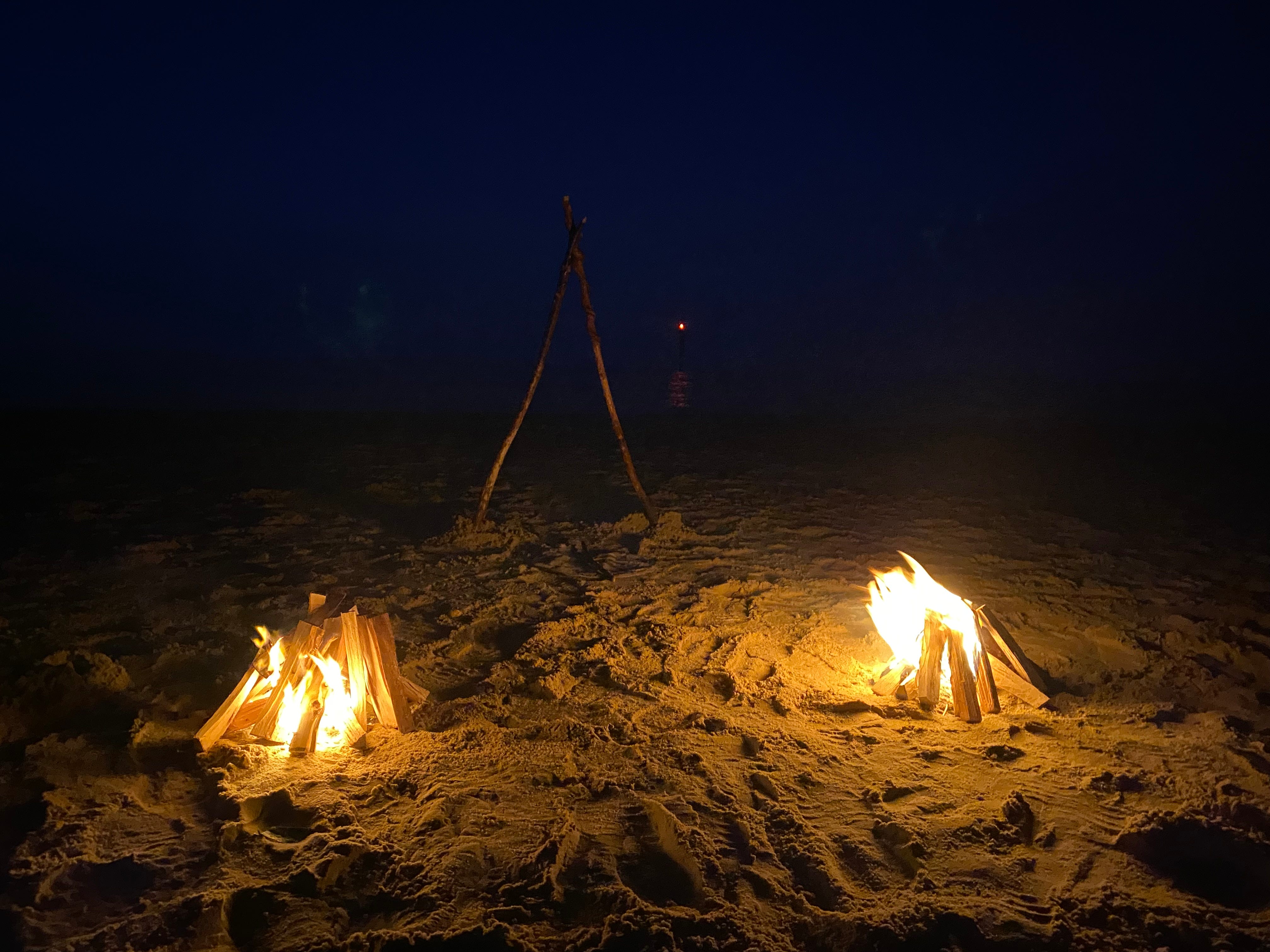
Twin Beltane fires to cleanse and bless all who pass between them. Each was lit with a bundle of twigs from nine different trees, admittedly hurriedly collected from the field next to our village hall! Waxham beach, Norfolk, 3 May 2026
Love Dylan Thomas, love John Clare, and really loved hearing about all the interesting things grabbing your attention in Norfolk this time of year. Thanks Imogen. Up in Scotland, things are a little behind. The oxeye daisies in my garden are still in tight bud!
Missed you. Hope hearth and home are slowly settling. Much love xx