Something Ancestral
devilish songs & pink icing

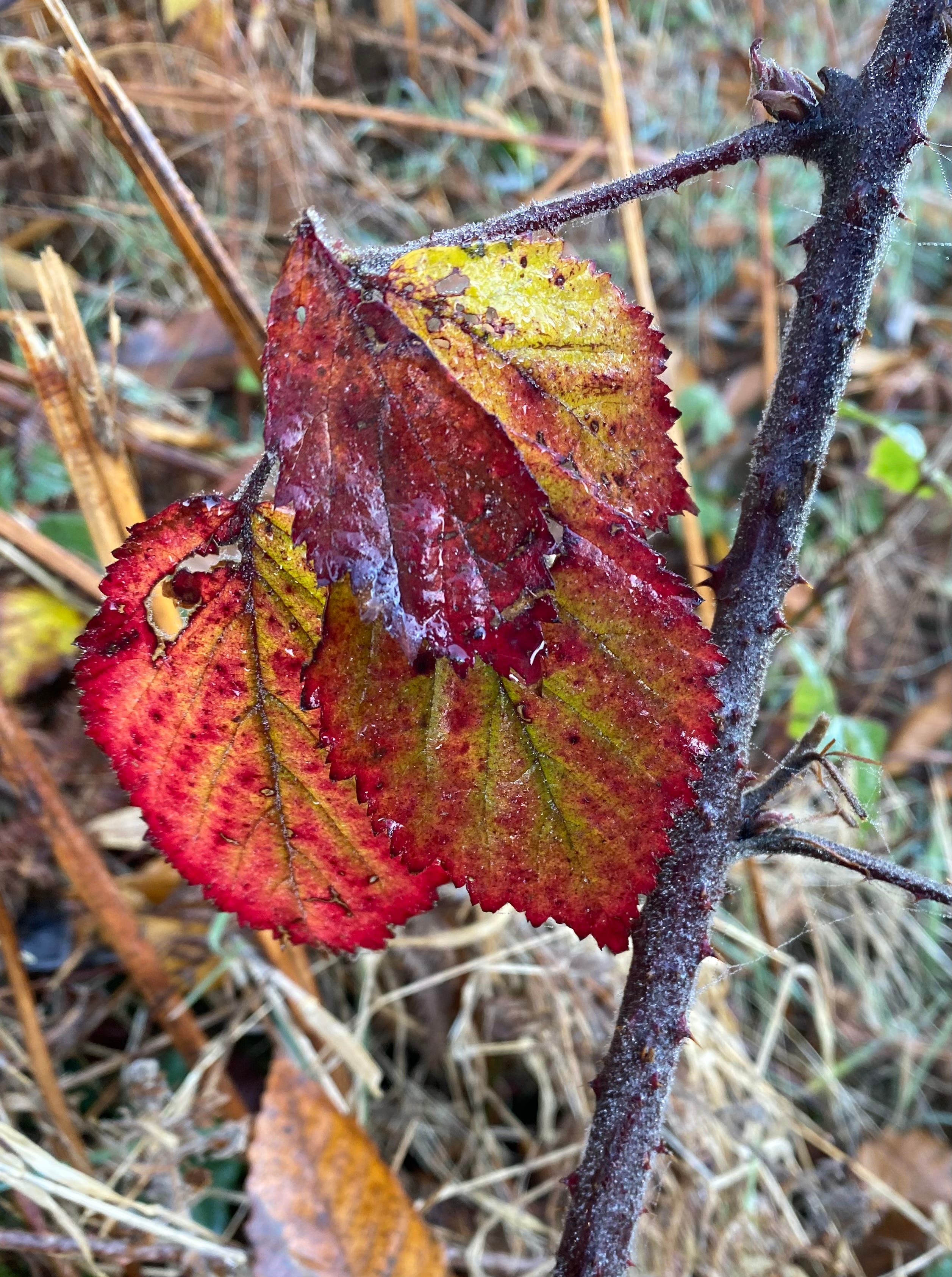
Blood red blackberry leaves along the track where the peasants may have marched to their last stand. Felmingham, Norfolk, 9 November 2025
Hello and welcome to this almost-Old-All-Hallows’ edition of Bracken & Wrack!
I relish these in-between days, when strangely unseasonal warmth turns to a cool misty drizzle the following day. Then there are the kind of gusty winds that send more and more of the birches’ golden treasure-drops spinning to the forest floor to join the ever deepening carpet.
True to form, on Sunday it was summery enough for a quick - and I mean quick - dip in the old canal, whereas today I’ve been glad to have a reason to settle down to catching up with writing and video editing. Every now and again a flurry of rain drops on the sitting room window brings me back to earth. I gaze out at the darkening dusk, noting with surprise that my neighbour’s tree across the lane has suddenly (it seems) lost nearly every leaf and is stretching blackened fingers towards a lead grey sky.
But that means it must be nearly time to light the wood stove, a ritual that never fails to cheer. Even if, truth to tell, this year’s strangely mild November might sometimes allow me to manage without that comforting glow.
After all, the flames aren’t only for us living-ones. The faded sepia and black and white photographs of parents, grandparents, great-grandparents - even my son - that were tenderly arranged on the bookcase before Samhain Eve remain there by tradition until Old All Souls’ Day on 15 November. I try to keep a tea light burning before their likenesses, and its flicker plays over ghostly faces, re-animating them for another year.
Inspired, perhaps, by these presences circling me, this edition of Bracken & Wrack has a decidedly ancestral air about it:
Plaited Prayers: a shrine for Hallowtide
My Hollowing Thumb: a slick of slip
At The Devil’s Instruction: the bishop & the lind-wurm
The Ballad of Geoffrey Lister: a new folk song
Dust, Cobwebs & Cracks: a party with the ancestors
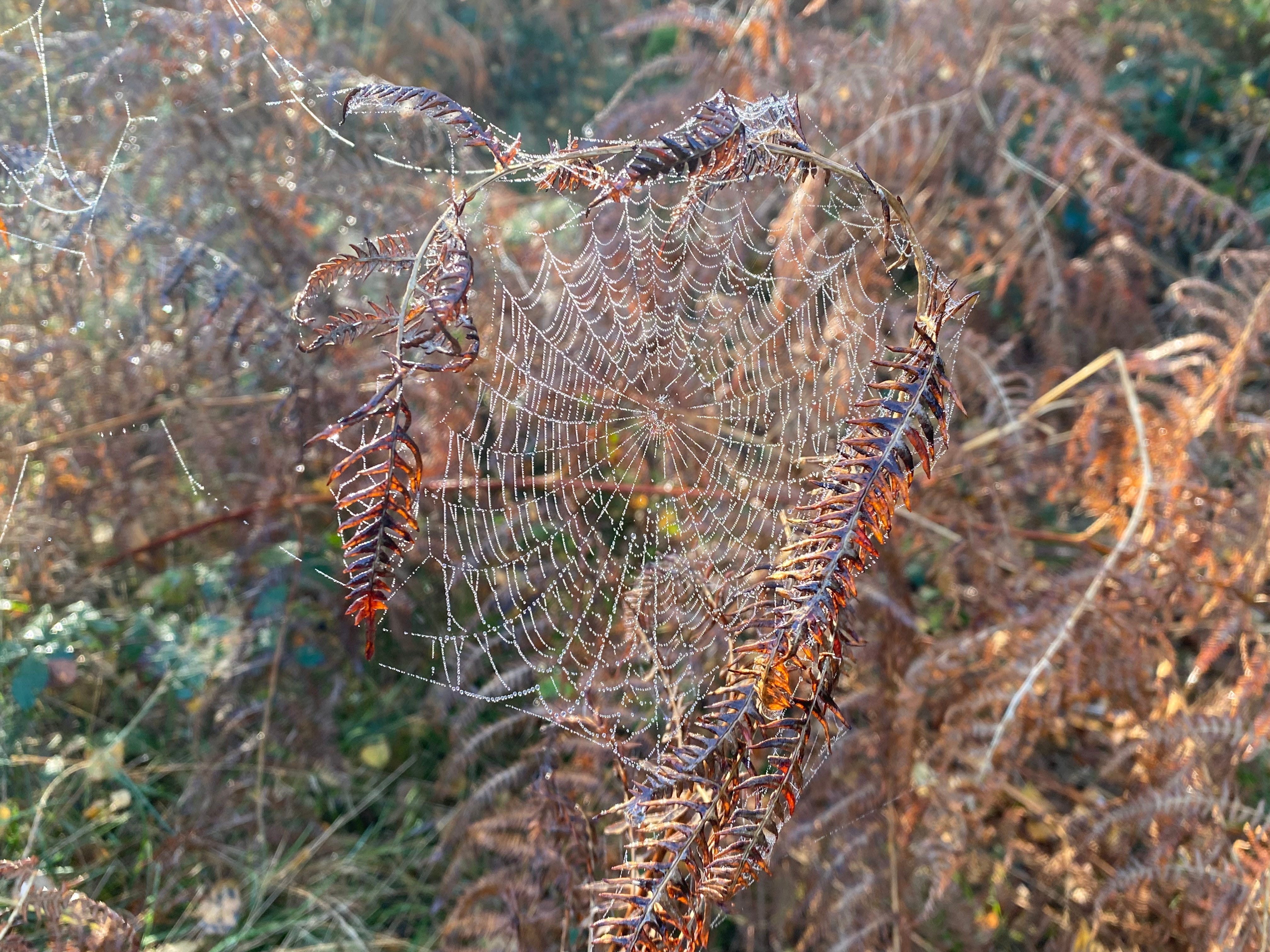
‘On Walsham Heath’ - cobwebs and bracken along the route probably taken by the rebels from Geoffrey Lister’s cottage in Felmingham, Norfolk, 8 November 2025
PLAITED PRAYERS: a shrine for Hallowtide
I had no idea that we would make a shrine. That’s where the wonder lies.
In truth, I would never have thought to do what you did with your deftly-woven offerings. As you hung them on a broom bush I noted the feather, broom seedpods, cracked and torn oak leaf, peaty acorn cluster and another feather, this one tiny and fluffy. A pair of plaited prayers swinging from the forks, one of them shaped like a lantern.
Lighting the way with a lantern; how perfect now, at Hallowtide. And how I adore the word ‘lantern’. Did you know that originally it was lant-horn as the panels were made from translucent slivers of horn rather than glass?
That reminds me - and this is a tangent but I know you won’t be shocked at the digression - that I want to make paper lanterns for Christmas this year. Let’s string them, loop them, arc them from wall to wall, window to hearth Make a shrine to the house spirits. Show them that love lies within and that the path ahead is illuminated, aflame with a thousand lanthorns.
It wasn’t me who had the idea to make a shrine to mark our place in the landscape. Nor did I realise in a flash that this was the very thing that was needed as a gift to the Fair Folk, the ancestors, the land wights and all unseen beings.
But I did know - if I racked my brains - that there was a mystery around broom. The Plantagenets (whose name connects to the Latin word for the genus) and the royal connection with witchcraft, perhaps? The Sprig of Broom by Barbara Willard (1971) delves into this, I seem to remember. I definitely need to re-read the Mantlemass sequence, Barbara’s classic historical series for children.
So what makes the broom feel so enchanted? Of course, true to its name it makes a good sweeping tool, whisking away old and uninvited energies. Perhaps that’s it.
Oh yes, and those seed pods. Hundreds of them. Brown, wrinkled, hanging by a thread. Well, I didn’t open one but you know what’s inside. A row - perfectly arranged - of moist black seed, rich and ready to take root and grow more magic.
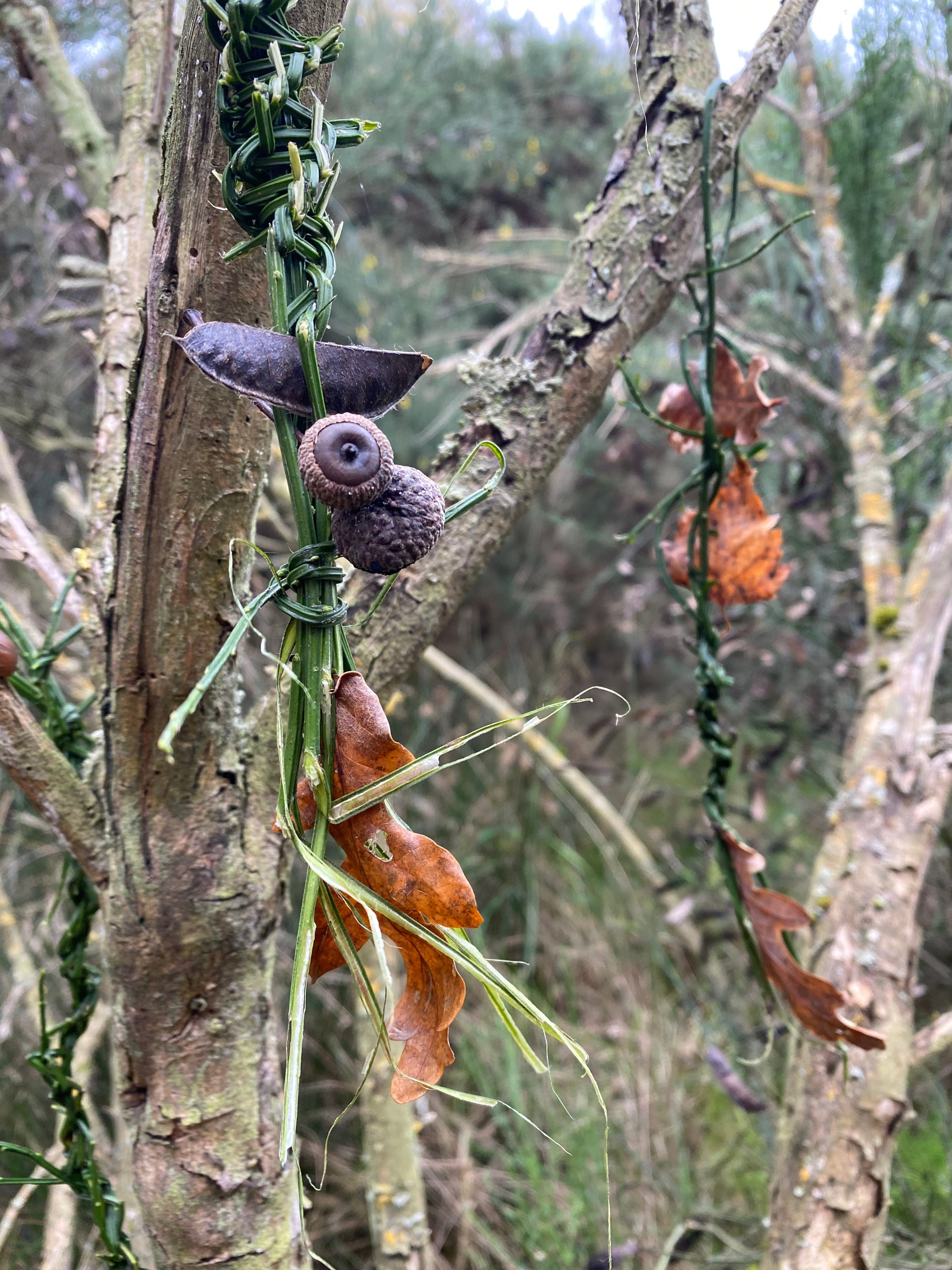
Gifts for the heath and woodland spirits, East Ruston, Norfolk, 8 November 2024
Upon entering the San Miguel cemetery in Oaxaca, we were offered steaming bowls of rich, dark hot chocolate and pan de muertos (bread of the dead) which is a shared consumption between the living and the dead. Colour predominates the scene as fire and candles illuminate the night glowing orange, the colour of the flower of death, the marigold. The perfume of these flowers blends perfectly with copal, burnt upon graves and altars throughout Mexico. Spectacular, imposing shrines line the quadrangle of tombs, dedicated to past dignitaries and revered members of the community. Constructed of arched reeds and sheaves of corn, the shrines are adorned with garlands of tangerines and flowers. Water too is set out to slake the insatiable thirst of the dead.
Shani Oates, Tubelo’s Green Fire
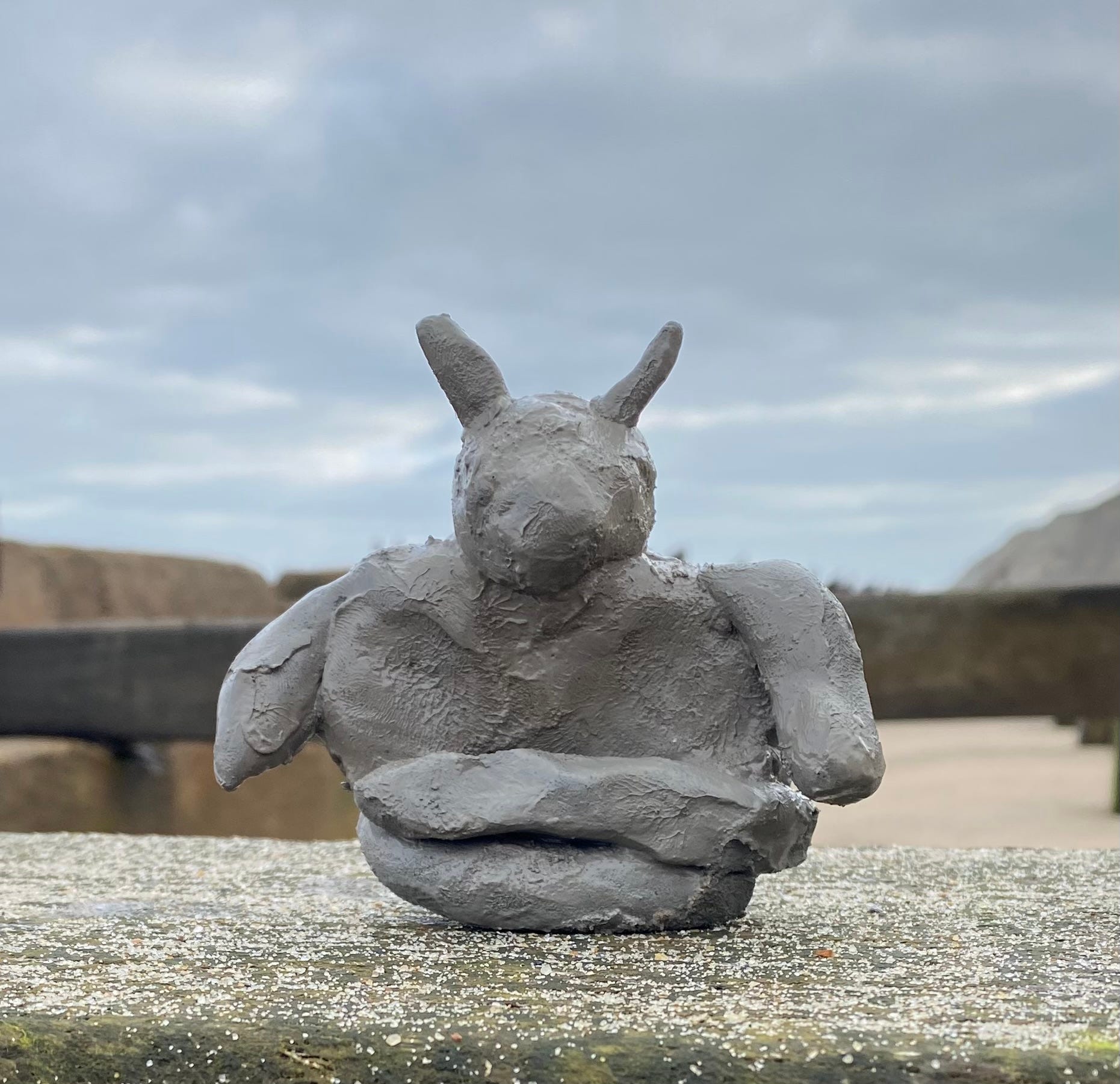
Something ancestral, Trimingham, Norfolk, 3 November 2025
MY HOLLOWING THUMB: a slick of slip
These cliffs are so much higher than I remembered, and the layers so clearly defined that I wonder why I’ve never noticed fossil hunters here. Well, apart from the ones who scour the sands for the barley-sugar belemnites that lie glistening between the stones. And that’s me, too. The little points are easy treasure when the tides have been generous. Rounded and granular, inviting touch.
But what we have here at the base of the cliff is pure clay. Clay that breaks off in cubed chunks, begging to be handled. Soft and silky with a grain when you squeeze it between your fingers. Yes, it’s clay all right, materia magica of a potter’s craft.
So let’s make something.
We break off a fistful each and moisten it in the lagoon that ripples in front of us. It’s a remnant of the last high tide mixed, I think, with the fresh water we spotted bubbling high on the cliff before trickling down in a slow sinuous thread. Surely these waters are all the more magical for that. And here we are, dipping the clay into them, working it between our fingers, squeezing and shaping it like the ancestors did.
Crouched, as I realise, in ancient pose, fully focussed on this single task.
Now the grey lump is kneaded and yielding but what shall I make? There are always too many possibilities for this indecisive Libra but I glance across and see you’re already busy with a torso. Then a head, arms, crossed legs. Are those horns or ears you’ve stuck on with a slick of slip?
There’s something ancestral here.
I shape a seal tail, or is it a half-forgotten memory of my selkie days? And a rounded bowl, thick-walled. I leave the indent of my hollowing thumb in the curve, a nod to the decorative finger nail prints circling Bronze Age beakers, urns, food vessels. A journey in intimacy in their very making. Even more so, perhaps, in their physicality as they were fingered, cradled and raised again and again.
Now the clay is all used up and our creations settle themselves into an arrangement on the crumbling sea defence, along with a few gifts from the shore. Incense smoke twists in spirals. I breathe it all in. And I find myself thinking about the spark that might crackle across the ages were I able to press my own finger nail into those ghostly grooves.
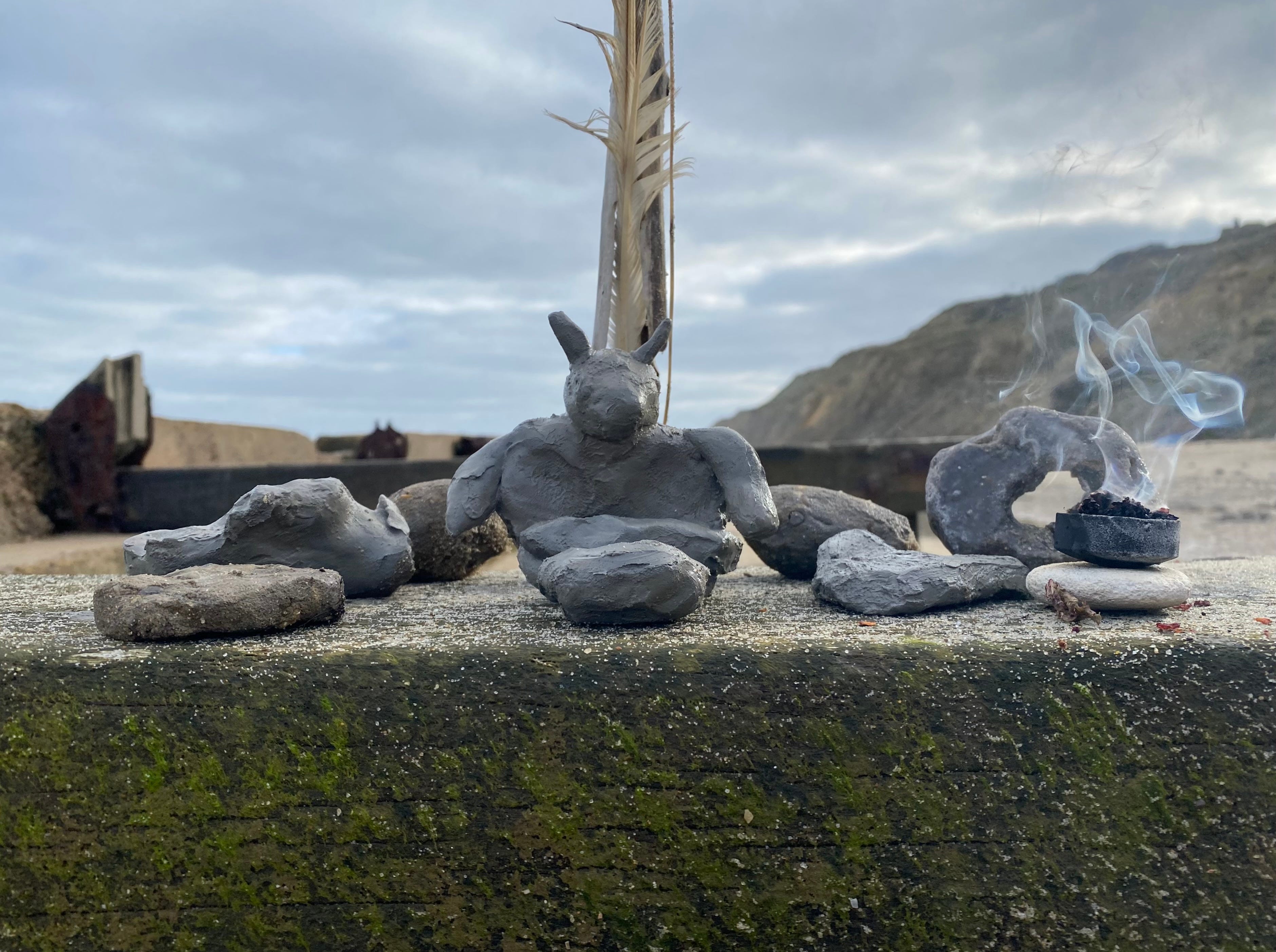
Sea-shrine with curling incense and a little November chill. Trimingham, Norfolk, 3 November 2024
AT THE DEVIL’S INSTRUCTION: the bishop & the lind-wurm
In the German Rhineland, about 40 miles south west of Frankfurt, lies a city called Worms. Indeed, as a pre-Roman foundation, Worms is one of the oldest cities in northern Europe. It was the capital of the Kingdom of the Burgundians in the early fifth century, and the setting of many ancient legends. Its cathedral is said to be one of the finest examples of Romanesque architecture in Germany, making me feel I would love to visit some day. One of Worms’ other claims to fame is that Liebfraumilch wine - that 1970s favourite of teenage party and cheese & wine evening alike - originated there.
As a prosperous free city in the High Middle Ages, Worms hosted more than 100 ‘imperial diets’. (I had to look up the word ‘diet’ which in this context means a legislative or parliamentary assembly.) But who wouldn’t giggle a little when reading that the infamous Diet of 1521, in which Martin Luther was declared a heretic, is commonly known as the Diet of Worms?
Its name may raise a smile, but where did it come from? The word Worms is of Celtic origin, meaning ‘settlement in a watery area’. In Latin this became Vormatia, while in contemporary Polish the city is Wormacia, so the evolution isn’t difficult to see.
But there is a far more colourful explanation, which I have a feeling that readers of Bracken & Wrack may like as much as I do. According to a legend first published in the 17th century, the city’s name actually comes from the story of the lint-wurm. Once upon a time, this mythical beast - something between a snake and a worm - appeared in the city of Germisa and began terrorising its inhabitants. As an aside, this scenario is very reminiscent of our own local legend of the Ludham Wyrm. (’Wyrm’ is an Anglo-Saxon word for dragon, especially the kind whose body terminates in a long tail end, as many of them do.)
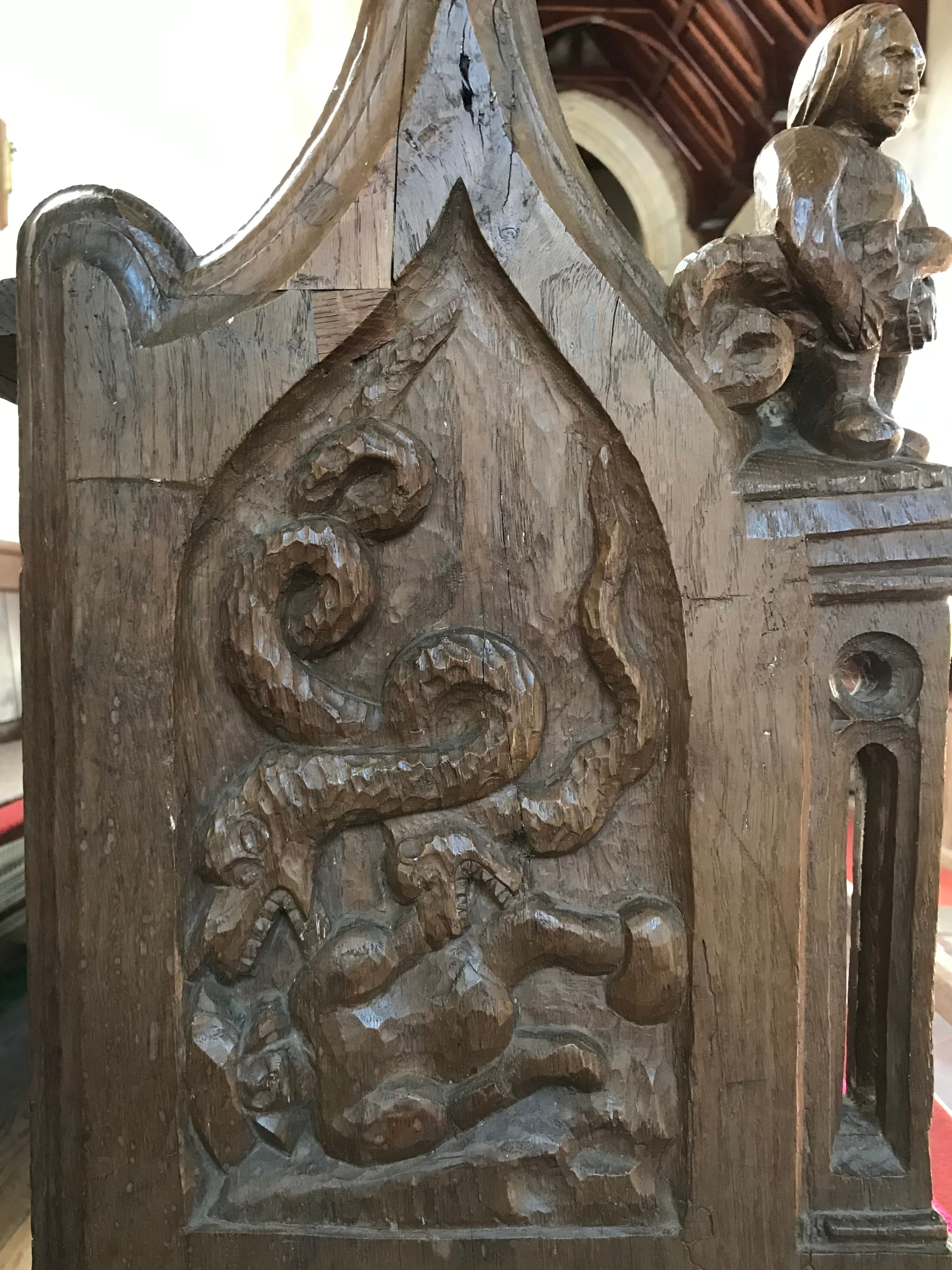
Looking suspiciously like the lint-wurm, this pew end in the church at Horning (near Ludham), Norfolk, may depict the famous Ludham Wyrm. Notice the enigmatic figure in the left hand corner who seems to have made friends with the wyrm. 21 March 2020
Each day, the people hold a lottery to decide which of them should be sacrificed to the lint-wurm in order to spare the city from destruction. Eventually, the lot falls on the queen herself. One of the city’s heroes refuses to allow her to sacrifice herself and offers to take her place on the condition that if he vanquishes the lint-wurm she will marry him. The queen agrees.
The lint-wurm duly swallows the champion but, protected by his armour, he is able to cut his way out from the inside before finishing the creature off. In the happy-ever-after, our hero marries the queen, becomes king, and renames the city ‘Worms’ to commemorate this tale.
Oops, now that really was an outrageous digression ;-)
So let’s turn our attention to one of the city’s most famous sons, Burchard of Worms, who was elected bishop of Worms in 1000 and died in 1025. Around 1008 Burchard began compiling books of canon law, the nineteenth of which he titled Corrector and Doctor since it was designed for priests in their role as spiritual ‘doctors’ correcting the ‘sickness’ of souls.
As John Shinners explains in his Medieval Popular Religion 1000-1500: a reader, this work offers ‘a memorable glimpse of some of the pre- or extra-Christian beliefs that were staples of popular religion to the never-ending exasperation of churchmen’.
Although Burchard gleaned some of his ‘more startling’ sins and penances from an earlier seventh century work, it’s thought that his detailed descriptions of practices involving, for example, the witch Hulda, the rain making ceremony and a variety of love potions are likely to have come from his own first hand encounters with current folk customs in his own diocese.
Shinners says that the full work is too long to reproduce in its entirety but he has picked out sections that deal explicitly with sins that stray into extra-Christian beliefs and magic. Each topic is framed as a question for the priest to ask those who come for confession.
Believe me, these topics are juicy indeed and very well suited to our themes here of folklore, magic and wild antlered saints. I have a feeling that Burchard is set to become an old friend of Bracken & Wrack, in much the same way that our Victorian Yorkshire wise woman has.
To begin, here are two seasonally-appropriate examples you may wish to ask yourself:
Have you eaten any offerings made to idols, that is, from offerings left at certain places at the tombs of the dead, or offered at springs, trees, rocks or at crossroads; or have you carried stones to cairns, or put wreaths on the crosses set up at crossroads? If you have done or approved of such, you should do penance for thirty days on bread and water.
Have you observed the funeral wake; that is, have you been present at vigils over the bodies of the dead where Christian bodies are watched over with pagan rites? Have you sung devilish songs there or danced those dances there that pagans devised at the Devil’s instruction? If you have, you should do penance for thirty days on bread and water.
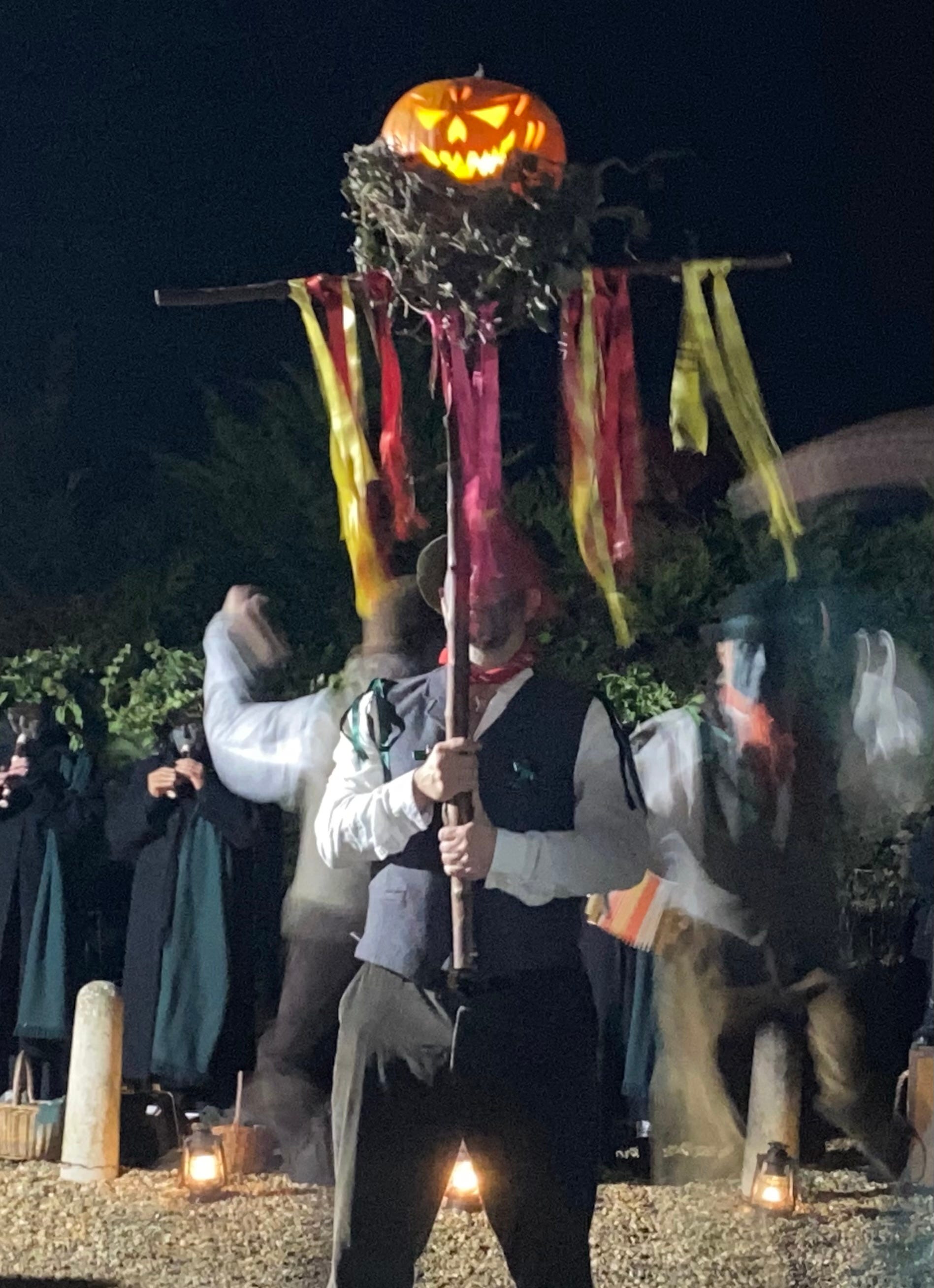
Old Glory Molly Dancers marking Samhain as the beginning of their dark dancing season, Rumburgh Buck, Suffolk, 31 October 2025
THE BALLAD OF GEOFFREY LISTER: a new folk song
On Walsham Heath, my recent offering for Between The Moons friends, was mainly made up of a behind-the-scenes video I shot when I went for a walk by footpath and field, tracing the route of the peasants who made their last stand in the Battle of North Walsham of 1381. In this video I talk a little about the story and we muse about the life and times of those ordinary people whose only defence against swords and arrows was pitchforks, scythes and other workaday tools.
As I explained in that post, my reason for the return visit - I’d already written a little about the site of the battle here in To The Ends Of The Earth last December - was that I was in the process of co-writing a folk song, commemorating the peasants’ last stand and the bravery of the thousands of peasants who died.
Well, that song is now ready - and arranged for guitar, voice, recorder and singing bowl. It’s perhaps still a little ragged around the edges but hopefully the spirit and love with which it was written will shine through.
To celebrate I made, umm, well don’t laugh but let’s call it a music video :-)
If you’d like to hear the song, which we’ve called The Ballad of Geoffrey Lister, you’ll find it towards the end of my late autumn YouTube update, Finding the Spark in the Dark Days.
The gently undulating field stretching before us is a poignant and nationally significant site, and I may be wrong but I have the feeling that very few of the town’s residents actually know it’s there. Which is all the more reason to stand quietly beside an old beech tree with its dips and hollows, offer our love to the rebels and leave a small gift for their leader who fought so passionately for the rights of the overlooked.
DUST, COBWEBS & CRACKS : a party with the ancestors
Purgatory per’ga-to-ri, a. - Where souls pass first through fire, then a cold salt lake, and finally over a thorny spiked bridge, to atone for lesser sins and unfinished penance.
Once upon a time I spent a year in a medieval church in the Norfolk countryside. Not that I actually lived in the church of St Andrew, Wood Dalling, but I got to know every inch of it as I spent lots of time there during that year, especially during the twelve important church festivals of the medieval year that I chose to mark.
But there was a twist, and long-time readers of Bracken & Wrack will have guessed it. As we are now running 13 days ahead of medieval time reckoning, each festival visit took place on the old Julian Calendar date so, for example, my Christmas encounter took place on the night of 6 January which is Old Christmas Eve.
Each time I started quietly, just noticing what was happening inside and outside and exploring how far I was able to share in the medieval world and how strange a ‘country’ it remained.
St Andrew’s is full of dust, cobwebs and cracks. And light, as there’s no stained glass there. In fact there’s nothing grand at all, but the church does contain a good number of brasses and ledger slabs to named individuals. Seeing the familiar names each time made me feel very close to these people who were born, lived, loved and died more than 500 years ago. In a broad sense they are ancestors to us all. They are part of us, and we are part of them.
In my art practice I have always been drawn to work in liminal locations, like crossroads, high places or bodies of water. It needs to be a site where repeated human activity has taken place. In England, churches before the Reformation had been repositories of magic, with their scents, colours, chanting and flickering candles. I wanted to try to tap into that; to see how far I could integrate myself into that world.
Each time I entered the churchyard, I arrived with no expectations except to record what happened while I was there. I gathered information by taking photographs, taking video, making rubbings, drawing and writing. Back at home I would reflect on the experience and my own life and passions. Half-remembered facts, myths and fairytales would swirl into the mix, too.
Mostly, these musings led to a return visit to enact a performance or create an installation that would have emerged and told me that it needed to happen in that space and to have its fleeting existence recorded.
Given that all this work rested on the imminent presence of the ancestors, I was expecting All Souls’ Day to be a powerful festival. It was. My visit took place on 15 November, thirteen days after today’s date for All Souls’.
The light in the empty church as the shadows lengthened was uncanny, highlighting the dust and the thick plastic sheeting that hung from the rafters, protecting the nave during renovation work.
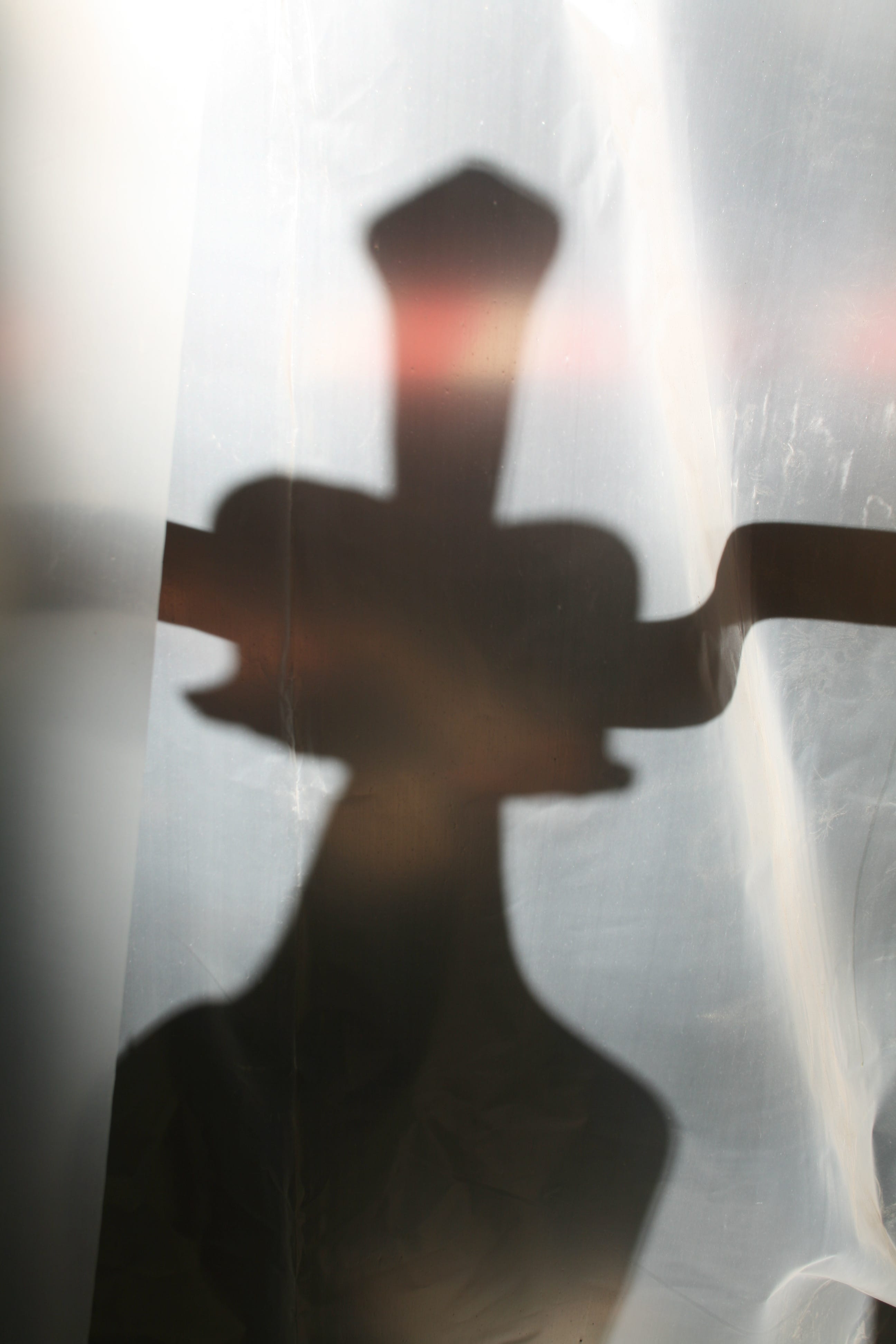
I say ‘empty’. But was it? Faces and suggestively human shapes blazed into life for a few seconds before fading back into obscurity. The place was chock full of presence. I felt the bones under my feet and I wanted to give them a party for their feast day. But what would they like?
Then I remembered soul cakes. These little biscuit-like buns were begged for by children during the medieval period and remain part of folklore and custom, secular and religious, all these centuries later. The pre-Reformation idea attached to the consumption of these cakes - which contain currants and are marked with a cross but are otherwise quite plain - is that each one eaten by the living, saves one of the dead from the tortures of Purgatory. This, as you may well know, was the place where the newly-dead would remain until their souls were deemed pure enough to enter heaven.
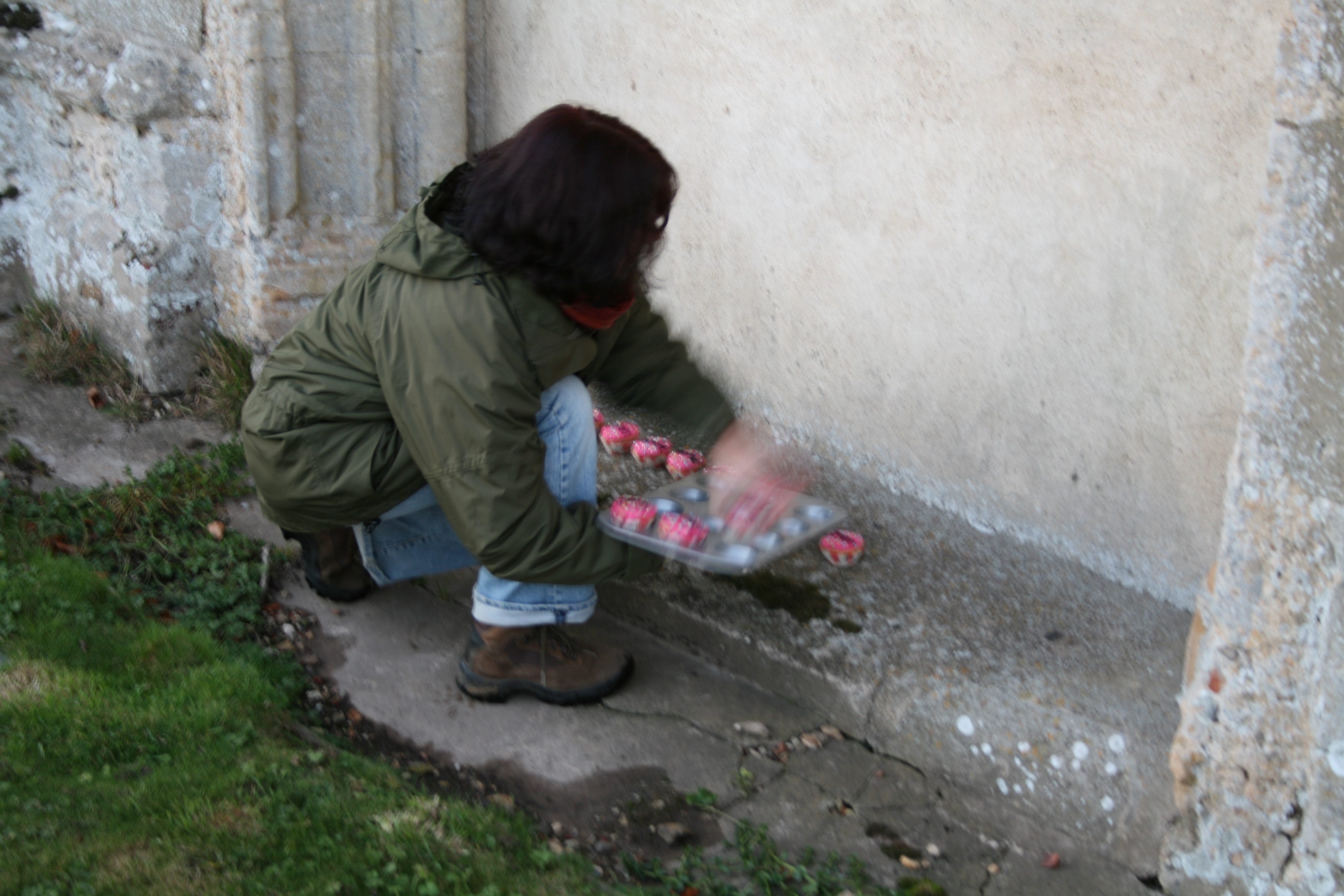
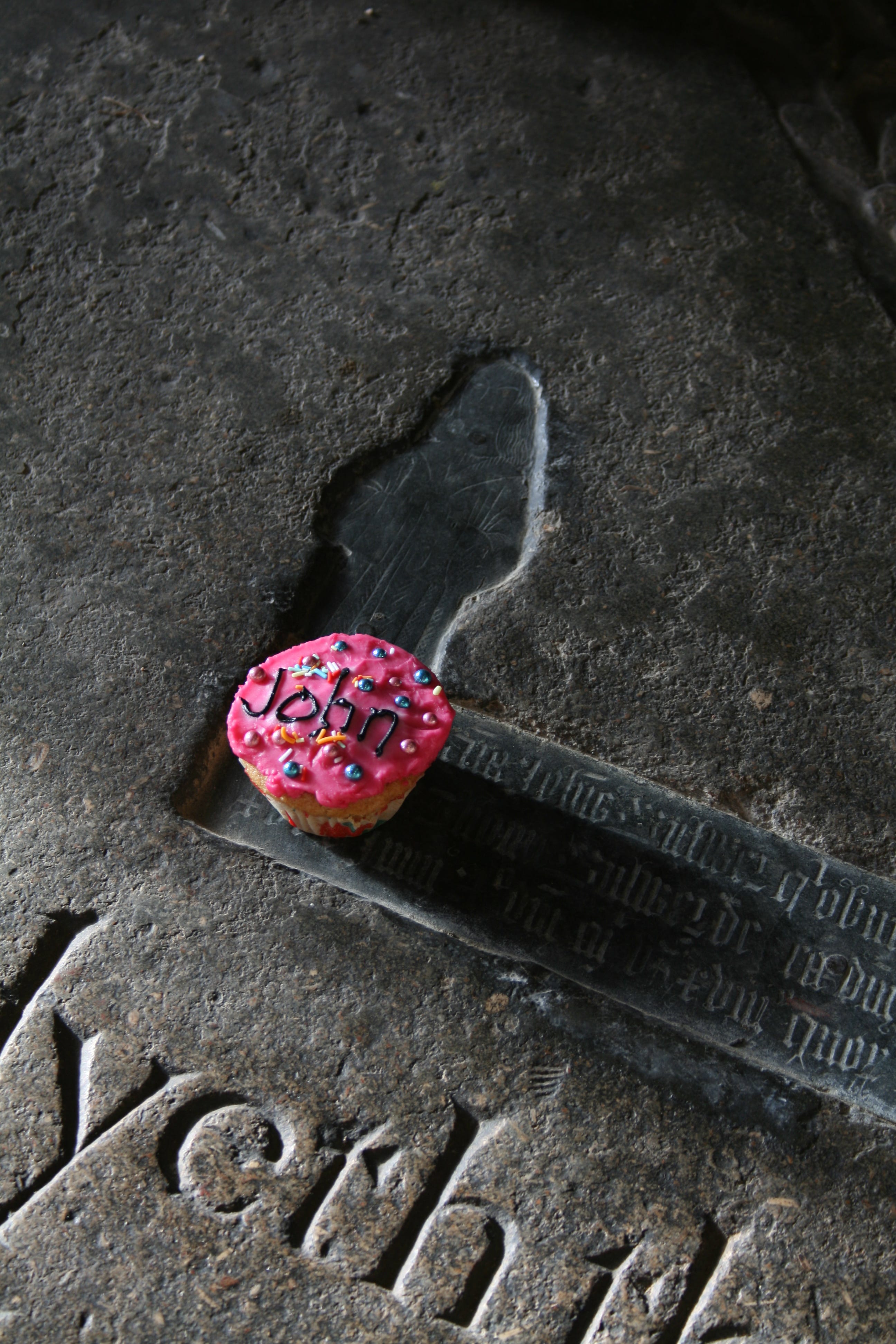
At the time of my project there was a massively popular fashion for decorated cupcakes in the UK. There were cupcake kits, cupcake parties, even wedding cakes comprised of teetering pyramids of them. So I decided to make and decorate a cupcake for each of the medieval people named on the brass plaques inlaid in the floor of St Andrew’s. Each one would, of course, be identified by name.
It was my gift to these people of Wood Dalling past, an offering from the living to the dead. And let’s face it, life in the old church was very quiet most of the time. They didn’t get out much.
As far as I could see, there were twelve named brasses. Some were just faint Latin inscriptions asking for prayers of an individual’s soul, while others included a figure. One of the Johns (and there were several) had a chalice and wafer as his portrait, suggesting that he was a priest. Ten men and two women. These two were Lettice and Katherine, who I rather warmed to since they were such a minority.
On arriving with my baking tin of cupcakes - conveniently, a 12-hole one - I first walked around to the south side and arranged them in the building’s ancient portal. Long blocked up, this back doorway of the church with its sunken ghost path between the gravestones was once its main entrance.
Inside, it was just me and them. And, of course, the myriad others with their unnamed graves and carvings and invisible footprints. As I arranged each cake on the appropriate inscription, I felt a tangible quiver.
All offered, I stood back and the luminous pink icing and gaudy decorations glows and pulsed among all those subdued greys, ochres, rusts and dust.
And then, moving quietly between the brasses, I took photographs.
A party with the ancestors. I don’t know which of us was more grateful - but I think it was me.
Until next time.
With love, Imogen x
From strength to strength!
You weave a beautiful story Imogen. These ancestors are not really in the past are they? They are woven into the landscape and you’ve brought them to life.